Battery Storage for Sunshine Coast Homes
5.0 on GoogleQLD licence 92489SAA accredited
Store your solar in the day, run your home on it at night, and keep the essentials on through a blackout. Sized honestly to your usage by a local SAA accredited installer, with the federal rebate applied up front in a fixed written quote.
The federal battery rebate steps down on 1 January 2027. Installs finished by 31 December keep the current rate.
Free estimate within 1 business day of receiving your photos and power bill. We can't estimate without photos, and we don't visit to estimate. Want the price locked in? Book a $299 design visit, credited back if you go ahead within 30 days of the visit. Book a $299 Design Visit →


SAA S6093214
MEA member 23598 · QLD licence 92489
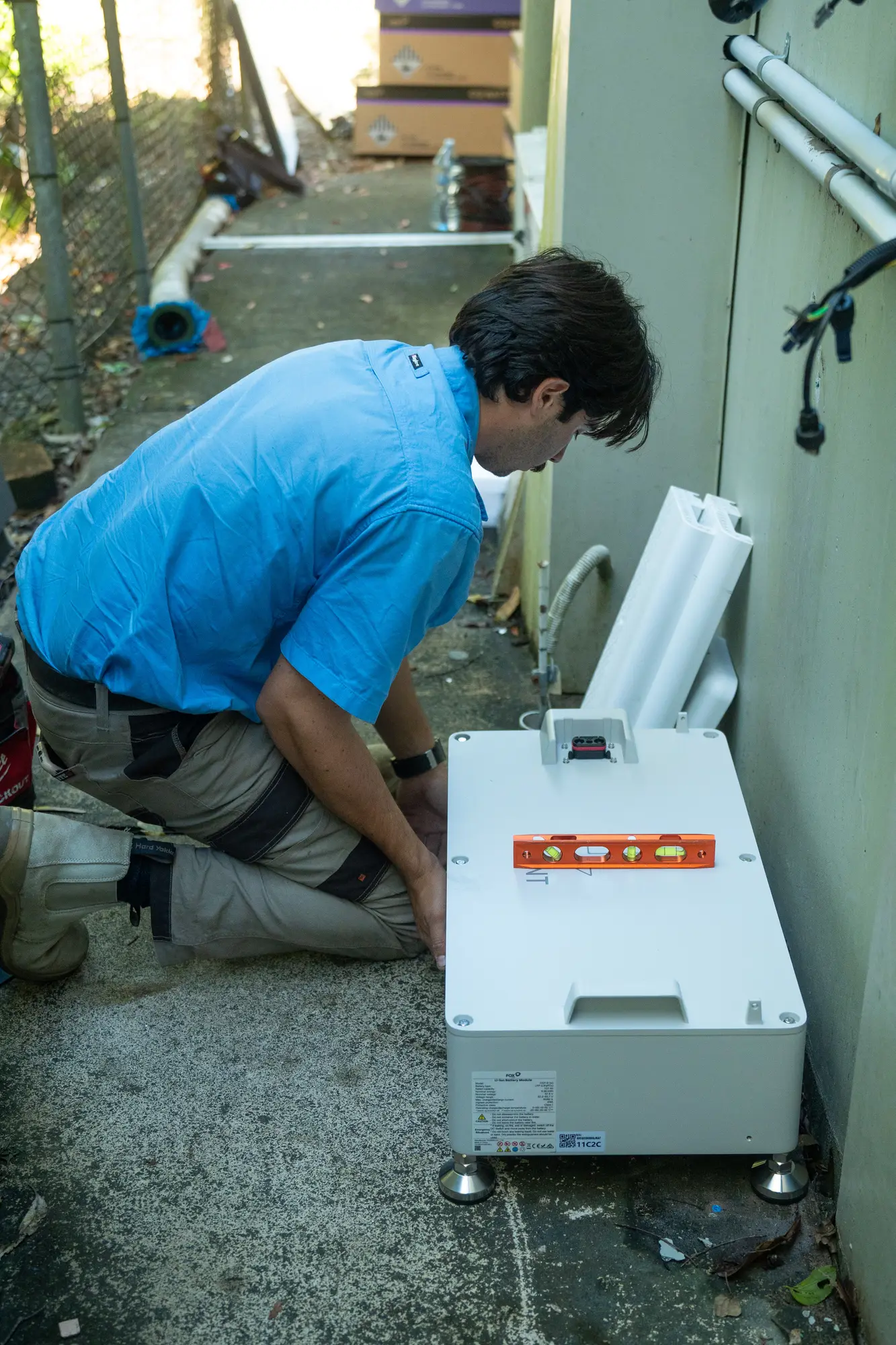
Battery storage turns rooftop solar from a daytime discount into a system that actually runs your home. Nuvolt designs and installs home batteries across the Sunshine Coast from our Nambour base: systems from GoodWe, Sigenergy, Fox ESS, Sungrow, SolaX and GreenESS, sized to your real evening usage rather than the biggest capacity a rebate allows, installed to AS/NZS 5139 and signed off by a licensed Queensland electrician. Rebate paperwork, network approval and any switchboard work are all handled in one fixed written quote.
How Battery Storage Actually Works
Four things the brochures skate past. Understand these and every quote you read, ours included, gets easier to judge.
kWh is how much, kW is how fast
Kilowatt hours measure how much energy the battery stores, kilowatts measure how fast it can deliver it. A battery with plenty of kWh but a modest kW rating will run the essentials for hours yet still struggle to start a big ducted aircon. We size both numbers to your home, not just the headline capacity.
Usable capacity is the real number
Manufacturers quote nominal capacity, but every battery holds a little back to protect its cells. The figure that matters is usable kWh, and that is the number we design around and the one your written quote shows.
A little energy is lost on the round trip
Storing energy and getting it back out is never perfectly efficient. Good lithium systems return most of what you put in, and we account for the losses when we model how far your battery will carry you into the evening.
LFP chemistry is the residential standard
Nearly every battery we install uses lithium iron phosphate (LFP) cells: the chemistry chosen for homes because of its thermal stability and long cycle life. Warranties on quality units typically run about ten years or a stated energy throughput, whichever comes first, and the exact terms appear in your quote.
The Right Size Is Your Evening, Measured
A battery earns its keep by cycling: charging from your solar every day and running the house every evening. Capacity that sits unused most nights does not pay you back, it just cost more up front. So we start from your bill and your usage pattern, work out what your home actually draws between sunset and sunrise, and size storage to carry that with sensible headroom.
The federal rebate scales with battery capacity, which tempts some retailers to quote the biggest battery a roof can justify. We would rather size it honestly and have the system pay for itself sooner. If your loads are about to change, an EV on order or a pool going in, we design for where you are heading, and prefer modular systems that can grow in steps.
Work out your own solar in 60 secondsCouple, modest evenings
Lights, fridge, cooking, TV and a few hours of aircon after work. Evening and overnight use often lands around 6 to 8 kWh, so a compact battery covers most nights without paying for capacity that never cycles.
Family home
Two or more bedrooms of aircon, a pool pump on a timer, dishwasher and washing running after dinner. This is the most common profile we quote, and it typically points at roughly 10 to 16 kWh of usable storage.
All electric, EV or pool
Big overnight loads change the answer: an EV can draw more in one charge than the rest of the house all evening. Here modular systems that can grow in steps, or charging the car straight from daytime solar instead, are usually the smarter design conversation.
Already Have Solar? There Are Two Ways In
Batteries connect to an existing system in two different ways, and the right one depends on the gear already on your wall.
AC coupled battery
The battery comes with its own inverter and connects alongside your existing solar, which keeps working untouched. Usually the cleanest path when your current inverter is newer and healthy, and it avoids reengineering a system that is doing its job.
- • Existing solar system stays as it is
- • Faster install, less rework
- • Suits newer inverters with years left in them
Hybrid inverter upgrade
Your existing inverter is replaced with a hybrid unit that runs the panels and the battery together. Often the smarter move when the old inverter is near the end of its warranty, and it leaves one integrated system managing everything.
- • One brand, one app, one point of support
- • Renews the heart of an ageing solar system
- • Opens the door to backup done properly
Want high capacity storage added to existing solar? See our battery retrofit offer →
Batteries We Fit, Chosen for the Site
We supply and install these ranges as a core part of our business, and we pick between them on your site, usage and warranty needs, not on commission.
GoodWe
The ESA range pairs storage with true on and off grid capability, and the Lynx batteries stack to suit the home. Our go to where backup resilience is the priority.
Sigenergy
SigenStor stacks inverter, battery modules and EV charging into one modular tower, so capacity can grow later without starting again.
Fox ESS
Strong value hybrid systems, plus the high capacity CQ7 retrofit sizes on our battery offer page for homes that want serious storage added to existing solar.
Sungrow
The SBR battery builds as a modular tower in steps, matched with Sungrow hybrid inverters. A proven pairing we install and support locally.
SolaX
Triple Power batteries alongside SolaX hybrid inverters. A reliable midrange option we have installed across the Coast for years.
GreenESS
Australian supported storage we fit where its sizes and warranty terms line up best with the home and the budget.
Trusted brands we install & recommend













What a Blackout Actually Looks Like
Not every battery keeps the lights on when the street goes dark: backup is a wiring decision made at design time, not a feature that comes in the box. When the grid fails, a backup capable system disconnects from the network for safety and picks up your nominated circuits after a short changeover. It is quick, but it is not an uninterruptible power supply, and we say so up front.
The wiring choice is between whole home backup, which runs your entire switchboard and demands a bigger inverter, battery and usually board work, and essential circuit backup, which keeps the fridge, lights, internet and a nominated few circuits running for longer at a lower install cost. Every circuit the battery backs up must carry a Type A RCBO under the standards, so the backup you choose decides the switchboard work, and we price all of it before you commit.
Whole home backup
Everything stays on, within the inverter's output limits. Needs capacity, load management and a board that is up to it. The premium option, and worth it for some homes.
Essential circuits
Fridge, lights, internet and the circuits you nominate. Big loads like ducted aircon, ovens and EV charging typically sit out the blackout, and the battery lasts hours longer for it.
No backup at all
A legitimate choice. The battery still cuts your bills every single day; it simply shuts down with the grid. Cheapest to install, and honest to offer.
Backup depends on the board behind it. See what a switchboard upgrade involves →
Placement Is a Standards Question, Not a Styling One
AS/NZS 5139, the Australian battery installation standard, decides where a home battery may and may not be mounted, and it rules out more spots than most people expect. This is the part of a battery quote that a phone estimate cannot get right, which is why our quotes start with eyes on your actual walls.
It is also where a local installer earns their keep: coastal Queensland heat, salt air and afternoon sun all shorten the life of electronics mounted in the wrong place, and we install for how these systems age here, not for the brochure photo.
What decides the spot
- →Not inside habitable rooms, under stairways or beside exit paths: AS/NZS 5139 restricts where a battery may be mounted, and we design around it from the start.
- →Clearances from windows, doors and vents are prescribed, so the neat spot on the wall is not always the compliant one.
- →In a garage, mechanical protection matters: a battery in the path of a parked car gets a bollard, exactly as our install photos show.
- →Outdoors needs the right enclosure rating and shade. Queensland afternoon sun on a west wall shortens the life of any electronics.
- →A shorter cable run back to the switchboard keeps installation cost down. We flag the tradeoffs of each candidate spot in the written quote.
The Rebate, Applied Up Front in Writing
The federal Cheaper Home Batteries program discounts the installed cost of eligible battery storage up front. The discount scales with usable capacity and depends on the certificate price and the install meeting every current standard, which is why it must be designed and signed off by an installer holding SAA battery accreditation, a separate class to solar. We hold both, under accreditation S6093214.
The discount value steps down on 1 January 2027 and continues stepping down after that, so the same battery costs more out of pocket after each step. The discount follows the date the system is installed and commissioned, not the date it is quoted, so a system installed before the step down gets the current, higher discount, and install calendars fill ahead of each step down. Your written quote shows the rebate already applied, and the discount you receive is the one in force on your install date.
Eligibility checked first
Battery model, your solar setup, switchboard condition and inverter compatibility all affect what qualifies. We confirm it for your home before quoting, not after.
Paperwork handled
Rebate claim, network approval and grid connection are all managed for you. You sign, we chase the rest.
Finance available
Finance is provided by Brighte Capital Pty Ltd, not Nuvolt Electrical. Brighte Green Loan from 9.49% p.a. (comparison rate 10.98% p.a.), 7 year term. Your actual rate and repayments depend on the amount financed, the term and your credit assessment, so they may be higher. Subject to approval. T&Cs and fees apply.
The full picture of rebates and finance lives on our rebates and finance page →
From First Look to Stored Power
Free Estimate or Design Visit
Ask for a free estimate and upload your bill and photos of the switchboard, meter, existing solar and where the battery could go through the secure link we send you, or book a $299 design visit and we check it all on site.
Your Estimate or Locked Price
The battery sized to your evening load, the federal rebate applied up front, and any switchboard work priced in. Free estimates come back within 1 business day of receiving your photos; after a design visit, the written design and locked in fixed price come back within 3 business days.
Approvals & Paperwork
Rebate eligibility, network approval and the grid connection paperwork are handled for you before install day.
Installation
Installed to AS/NZS 5139 by our SAA accredited team and signed off by a licensed Queensland electrician, typically in a day.
Handover & Support
Monitoring set up on your phone, backup behaviour demonstrated, and local support afterwards from the crew that installed it.
Battery Storage Questions
Straight answers on sizing, backup, rebates and what a battery can and cannot do, from the contractor doing the installs.
What size battery storage does my home need?
Start from your evening and overnight usage, not the biggest number the rebate allows. Your electricity bill shows daily kWh; the share you use after the sun drops is what the battery has to carry. For many Sunshine Coast homes that lands between 10 and 16 usable kWh, smaller for couples with modest evenings, larger for all electric homes. We meter it against your real usage, from your bill or at a design visit if one is needed, and put the sizing logic in the written quote so you can see why the number is the number.
Will a battery run my air conditioning during a blackout?
It depends on the system's backup output in kW and how the backup is wired, not just the battery's size in kWh. Essential circuit setups usually keep the fridge, lights and internet running and leave big loads like ducted aircon, ovens and EV charging off. Whole home backup with a larger inverter and load management can run more. We explain exactly what stays on before you commit, because backup that does less than you expected is the most common battery complaint in the industry.
Is switching to battery power instant when the grid fails?
No battery hands over instantly, and anyone who tells you otherwise is overselling. When the grid drops, the system disconnects from the network for safety and picks up your backed up circuits after a short changeover. For most systems that is quick enough that clocks and wifi ride through, but it is not an uninterruptible power supply, and sensitive equipment that cannot tolerate any interruption needs its own UPS regardless of the battery brand.
How long does a home battery last?
Quality lithium iron phosphate batteries are typically warranted for about ten years or a stated amount of energy throughput, whichever comes first, and keep operating past that at gradually reduced capacity. Cycling the battery daily is what it is designed for. The exact warranty terms differ between brands, which is one reason your written quote names the specific battery and its warranty rather than a generic promise.
Do I need solar panels to add battery storage?
A battery pairs best with solar: it stores the daytime generation you would otherwise export for little return and gives it back in the evening. The federal Cheaper Home Batteries program is built around batteries working alongside new or existing solar, and eligibility depends on your setup, so we confirm it for your home before quoting rather than assuming. If your existing solar system is older we also check the inverter side, because that determines the cheapest way to connect storage.
Can I add a battery to my existing solar system?
Almost always, and there are two paths. An AC coupled battery connects alongside your existing inverter and leaves the working system untouched, which suits newer solar. Replacing your inverter with a hybrid model brings solar and storage under one unit, which can be the better move when the existing inverter is near the end of its life. We quote the path that fits your gear and say why, and our battery offer page covers the high capacity retrofit packages.
Is the federal battery rebate ending?
No, but it steps down. The Cheaper Home Batteries program discounts the installed cost up front, and the discount value reduces on 1 January 2027 and continues stepping down after that. The discount follows the date the battery is installed and commissioned, not the date it is quoted, so a battery installed before a step down gets the higher discount, and install calendars fill ahead of each step down. Your written quote shows the rebate applied, and the discount you receive is the one in force on your install date.
Should I join a virtual power plant (VPP)?
A VPP pays you credits in exchange for some control over when your battery charges and discharges. For some households that stacks up; others prefer to keep every stored kWh for their own evening. We install batteries so the choice stays yours: nothing we fit locks you into an operator, and you can join or leave a program later as the offers change.
Can battery storage take my house off the grid?
Most homes keep the grid connected as a backstop and use the battery to cover the evening and outages, which is the economic sweet spot. Going fully off grid is a different design: it needs a generous solar array, much larger storage, usually a backup generator, and honest modelling of cloudy weeks. We build both, so if off grid is the goal, start with our off grid page and we will design for it properly rather than stretching a suburban system past what it can do.
Who does the work, and what warranty covers it?
Every system is designed and installed by our own SAA accredited team (battery accreditation is a separate class to solar, and we hold both under S6093214) and signed off by a licensed Queensland electrician, installed to AS/NZS 5139. The manufacturer warranty covers the battery itself and our lifetime workmanship warranty (conditions apply) covers the install. Finance is available through the Brighte Green Loan, from 9.49% p.a. (comparison rate 10.98% p.a.) over a 7 year term, subject to approval.
Thinking beyond the battery? Solar and battery together → · Fully off grid → · Add an EV charger → · Batteries for a business site →
Before you buy: Reading a battery quote → · The federal battery rebate → · Three phase homes →
Get a Free Estimate for Battery Storage
Tell us about your home, your power use and whether you already have solar. We size the right battery for your evenings, apply every rebate you are eligible for, and give you a written estimate, confirmed before anything is ordered.
- →SAA accredited for battery and solar, licensed & insured, direct from the contractor
- →Rebate and finance paperwork handled for you
- →Nambour based, installing across the Sunshine Coast and greater QLD
Send your enquiry
Takes 30 seconds. We reply within 2 hours during business hours. If it is urgent, call 0494 826 740.
Where we do this
Battery installs run across the whole Coast and beyond, and these are the suburbs where we quote and install most weeks.