What actually fails on a solar system after ten years

By Daniel Carmont, licensed electrical contractor Lic# 92489
Nuvolt Electrical Solutions · 26 August 2026 · 9 min read
A very large share of the solar on Sunshine Coast roofs went up between about 2012 and 2018: mostly 3 to 6 kilowatt string systems, bought when panels first became cheap and put in fast. Those systems are now entering their second decade, and they are the ones I get called out to.
I am a licensed electrical contractor on the Sunshine Coast (Lic# 92489) and an accredited solar installer. This is what actually fails on a ten year old system, in roughly the order I see it, what it looks like from the ground, and what to do about it. Not a list of scary things; most of it is cheap to fix and some of it costs nothing but a look.
The rooftop DC isolator, still the number one fault
If your system went in before 2021 there is a switch in a grey or black box on the roof beside the panels, and it is the single most likely thing on the whole installation to have failed. Australia required those rooftop isolators for a decade, the rest of the world largely did not, and the 2021 revision of the wiring standard for solar dropped the requirement for new installs. The ones already fitted are still up there, in full sun, on the hottest part of the house, and they are ten years older than they were.
They fail two ways. The slow way is water: the seal or the gland gives up, the box fills after a storm, and the terminals corrode until one morning the inverter reports an insulation or earth fault. The telltale is a system that throws a fault on wet or dewy mornings and clears itself by lunchtime, which owners often live with for years. The fast way is heat: a loose or corroded terminal on a DC circuit arcs, and DC arcs do not blow themselves out the way AC ones do. That is the burnt lid, the melted box and, occasionally, the fire brigade.
I wrote the whole story up in the most dangerous part of your solar system, including why you should never operate the DC isolator first when shutting down. The short version for a ten year old system: have the rooftop isolators inspected, and if the box is discoloured, cracked, or the lid no longer seals, replace it before it replaces itself. It is a small job and it is the best value repair on this list.
The failure nobody notices: the monitoring went dark
This one costs nothing to find and it is the most common thing I discover on an old system: it has not been producing properly for months, sometimes years, and nobody knew because nobody was looking. The inverter's little display is in the garage, the app stopped updating long ago, and the power bill went up slowly enough to blame the tariff.
There are three ordinary reasons the monitoring stopped. The WiFi password changed when the modem was replaced and the inverter was never reconnected. The online portal account lapsed or the portal itself was retired by the manufacturer. Or, for a lot of 2013 to 2016 systems, the monitoring ran on a 3G mobile dongle, and Australia's 3G networks closed through 2024, the last of them in October that year. Those dongles went silent overnight and the system carried on with nobody watching.
The five minute test: on a clear day around lunchtime, read the inverter's own screen. You want the daily production figure and the current output. A healthy north facing system on the Coast averages roughly 4 kilowatt hours per kilowatt of panels per day across a year, more in summer and less in winter, so a 5 kilowatt system that shows 3 kilowatt hours at 1 pm on a sunny day has a problem. A screen that is blank, or a green light with a red one beside it, is the problem. Then compare the export figure on your bill with the same quarter a year earlier. Get the monitoring back online first, because everything else on this list is easier to catch when someone is watching.
The inverter, and what its warranty actually covered
Inverters are the working part of a solar system and they have a working life. Ten to fifteen years is the honest expectation for a good string inverter, and the warranties of the 2013 to 2018 era were commonly five years, sometimes ten if the owner registered it, which many did not. So a ten year old inverter is at or past the end of its cover, and the fans, capacitors and relays inside it have done ten summers in a Queensland garage.
The failures look like this: a display that has died while the unit keeps working, which is harmless; a unit that runs but shuts down on hot afternoons, which is usually a cooling problem and a warning; error codes on startup in the morning that clear later, which is often the rooftop isolator rather than the inverter; and the full stop, where the lights are off or red and production is zero. Some of the brands sold cheaply in that period no longer have an Australian presence, which means no warranty and no spare parts, and the honest answer for those is replacement rather than repair.
Two things to know before anyone replaces an inverter. In Queensland any change to the inverter on a solar connection goes through Energex as a connection application, lodged by your electrician through their portal, whether it is a like for like swap or an upgrade. And if you are one of the households still on the 44 cent Solar Bonus Scheme feed in tariff, the scheme's own conditions let you replace the inverter with one of the same or smaller capacity and keep the tariff, but a larger one ends it. That tariff runs to 1 July 2028, so the arithmetic on a bigger replacement is worth doing properly rather than assuming. If the inverter is dead anyway, this is also the moment to decide whether a hybrid inverter and a battery makes more sense than a straight replacement; I go through that decision in hybrid inverter or AC coupled retrofit.
Roof penetrations, cable, conduit and racking
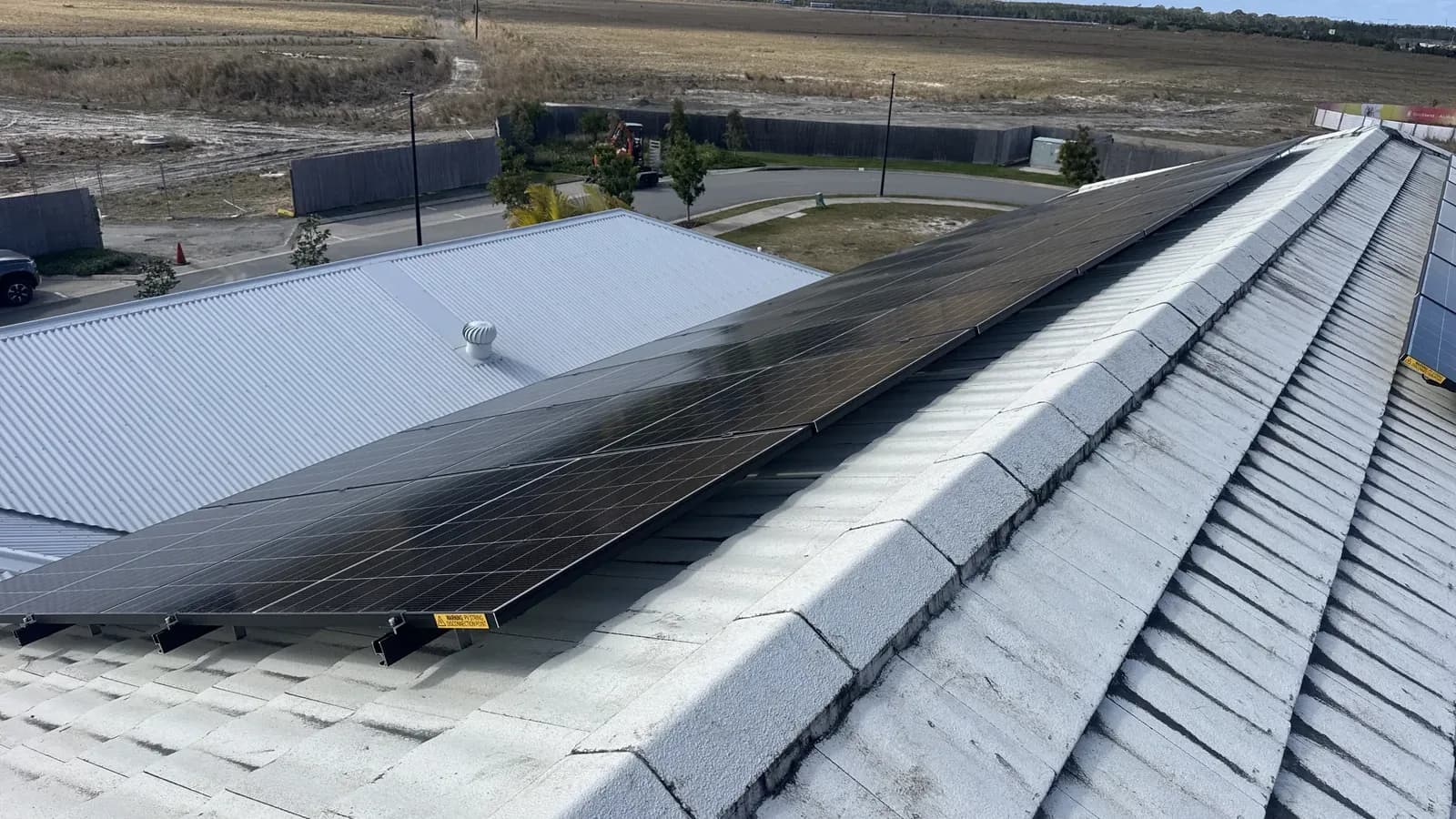
The parts of a solar system you cannot see from the ground are the parts ten years of sun, salt and possums have been working on. On tile roofs the mounts sit on brackets under the tiles, and the tiles around them are the ones that get cracked by the next person up there, the aerial installer or the gutter cleaner. A cracked tile under an array is a leak that only shows up in a heavy storm, usually as a stain on the ceiling under the panels.
Conduit is the quiet one. Some early installs ran the DC cable in ordinary grey conduit that was never rated for sun, and after a decade it goes chalky and brittle and cracks, leaving DC cable exposed to weather. Cable ties that were not UV rated have long since snapped, so cable that was neatly clipped is now lying on hot tin or hanging under the array where possums and birds nest in it. Nesting under panels is a real Coast problem: the debris holds water against the roof and the cable, and the animals chew.
Near the beach, add corrosion. Rail clamps, earth lugs and mid clamps on cheaper racking rust, and a rusted earth connection on the array frame is a safety fault, not a cosmetic one. If you are within a couple of kilometres of the surf, the whole subject of solar on salt air coastal homes applies to you, and a ten year old system is exactly the age at which it starts to show.
Panels: less than you fear, and not what you expect
People assume the panels wear out. Mostly they do not. A decent panel loses a fraction of a percent of output a year, and the performance warranties of that era promised somewhere in the mid 80s percent of nameplate at 25 years, which is why a ten year old array should still be doing over 90 percent of what it did new. If your system is down by a third, it is almost never gradual panel ageing. It is a fault.
The panel faults I actually find are specific. Hot spots, where a shaded or cracked cell heats up and eventually discolours the backsheet; on an older array these show up in a thermal scan long before they show up in the output. Microcracks from someone walking on the panels. Delamination and moisture ingress at the edges on the cheaper panels of the 2012 to 2016 period, often visible as browning or the snail trail pattern along the cell lines. Failed bypass diodes in the junction box, which take a third of a panel out and are invisible from the ground. And plain dirt: a shaded, grimy, bird fouled array under a tree does not need replacing, it needs cleaning and the tree trimmed.
The other thing that has changed is the panel manufacturers themselves. Several brands that were common on Coast roofs in 2014 no longer sell in Australia, and a panel warranty is only as good as the company still standing behind it. That matters when deciding between repairing a failed panel and replacing an array, which I come to below.
The switchboard the solar was bolted onto
In 2013 the solar went onto whatever switchboard the house already had, and on a lot of Coast houses that was a board from the 1980s or 1990s with ceramic fuses, a single safety switch covering half the circuits, and no spare ways. The installer added a solar supply main switch and a breaker, usually in the last available space, and everyone moved on. Ten years later that board is the oldest part of the whole system and often the least safe.
What I check on it: that the solar main switch is present, labelled and operating; that the solar circuit's breaker and terminals show no sign of heat; that the safety switch protection actually covers the circuits it should; and whether there is physically room for anything else, because if you are thinking about a battery, an EV charger or air conditioning, an old board with no space is where the quote grows. The general costs of bringing a board up to date are in what a switchboard upgrade costs on the Sunshine Coast, and the work itself is on the switchboard upgrades page.
What a proper inspection checks, and what repairs cost in Queensland
A real solar inspection is not a glance at the inverter light. Mine covers the rooftop isolators and every DC connection, the string voltages and currents one string at a time so a weak string stands out, the insulation resistance of the DC wiring, the earthing continuity of the array frame and rails, the condition of conduit, cable, clamps and roof penetrations, the inverter's settings, cooling and error log, the switchboard, and the signage and labels that are required to be there. On older arrays I add a thermal imaging pass, because a hot cell or a warm terminal is visible in a scan a year before it fails. The output of all that is a written report of what is fine, what needs doing now and what can wait, and that report is worth having even if you do nothing with it this year.
General Queensland market ranges, not a price list. Replacing a rooftop DC isolator is usually a few hundred dollars. Reclipping cable, replacing degraded conduit and making good a cracked tile is small, labour priced work. Replacing a typical 5 kilowatt single phase string inverter supplied and installed commonly lands between $1,500 and $3,000, more for larger or three phase units, plus the network application. A thermal scan and full inspection is priced as a service visit. Replacing a whole array is a new system, and belongs in the next section.
I offer this as a preventative maintenance visit, and for a system that has clearly got a problem the quickest path is a free estimate: upload photos of the inverter, its error screen and the isolators through the secure link we send you, and the estimate comes back within 1 business day of receiving them. If something can't be confirmed that way, I'll explain why, and a $299 design visit may be needed, credited back if you go ahead within 30 days. The one thing I would ask is that you do not get up on the roof yourself. Ten year old panels, brittle conduit and live DC are not a Saturday job.
Repair or replace: the sums on an old system
Here is the decision most owners of a 2014 system face when the inverter dies. You have a 3 or 5 kilowatt array of panels that are fine but small, on a roof that could carry two or three times as much, and a dead inverter that costs real money to replace like for like. Replacing the inverter keeps a small system running. Replacing the system gets you a modern array, a hybrid inverter that can take a battery now or later, new warranties, and the rooftop solar certificates on the new panels, which a straight inverter swap does not earn.
The exceptions are real and I would rather you knew them. If you are on the 44 cent tariff, a bigger system ends it, and on a house that exports a lot that tariff can be worth keeping until it expires in mid 2028; that is a calculation with your bill in hand, not a slogan. If the panels are a brand still supported in Australia and are testing well, keeping them and replacing only the inverter is a perfectly good decision, and it is one I make with customers regularly. And if the roof itself is due for replacement, do that first; nobody wants to take an array off a two year old system to fix the roof under it.
If you want the whole picture worked through properly, the $299 solar and battery design visit does exactly this: the existing system tested, the roof, the board and the metering checked, and a written design you keep and a locked in fixed price within 3 business days, with the $299 credited back in full off the installation if you go ahead within 30 days of the visit. Most of the ten year old systems I see are worth keeping. Some of them are worth a lot more as the foundation for something bigger. The point of an inspection is to know which one you own.
Common questions
How long does a home solar system last?
The panels are the long lived part: a decent panel is still doing over 90 percent of its original output at ten years and the performance warranties of the 2013 to 2018 era run 25 years. The inverter is the working part and ten to fifteen years is the honest expectation, with warranties from that period commonly five years. Rooftop DC isolators, conduit, cable ties and clamps are the things that actually fail first.
How do I know if my old solar system is still working properly?
On a clear day around lunchtime read the inverter's own screen for the current output and the daily total. A healthy north facing system on the Sunshine Coast averages roughly 4 kilowatt hours per kilowatt of panels per day across the year, more in summer. Compare the export figure on your bill with the same quarter a year earlier. If the monitoring app stopped updating, get it reconnected first: many 2013 to 2016 systems used 3G dongles that went silent when the 3G networks closed in 2024.
Why does my solar inverter show a fault in the morning that clears later?
Very often it is water in a rooftop DC isolator rather than the inverter. Dew or overnight rain gets past a failed seal, the inverter reports an insulation or earth fault at startup, and the box dries out by lunchtime. It is a warning, because the same moisture corrodes the terminals until one of them arcs. Have the rooftop isolators inspected and replaced if the box is discoloured, cracked or no longer seals.
Can I replace just the inverter on my old solar system?
Usually, yes, if the panels are testing well and their brand is still supported in Australia. In Queensland any inverter change goes through Energex as a connection application lodged by your electrician. If you are on the 44 cent Solar Bonus Scheme tariff, a replacement of the same or smaller capacity keeps the tariff and a larger one ends it. A dead inverter is also the moment to decide whether a hybrid inverter and battery makes more sense than a like for like swap.
Do solar panels need cleaning on the Sunshine Coast?
Panels on an open, pitched roof mostly clean themselves in rain. Panels under trees, near the surf, on low pitches or above a busy road collect grime, salt, bird fouling and leaf litter that rain does not shift, and a dirty or shaded array is often mistaken for a failing one. Cleaning and trimming the tree is far cheaper than replacing panels that were never the problem.
What does a solar system inspection include?
The rooftop isolators and every DC connection, string voltages and currents measured one string at a time, insulation resistance of the DC wiring, earthing continuity of the array frame, condition of conduit, cable, clamps and roof penetrations, the inverter's settings, cooling and error log, the switchboard, and the required signage. On older arrays a thermal imaging scan finds hot cells and warm terminals well before they fail. You should get a written report of what is fine, what needs doing now and what can wait.
Ask us about your place
Tell us what you have and what you are after. You get a written quote from the licensed contractor who does the work, and we reply within 2 hours during business hours. If it is urgent, call 0494 826 740.