The Most Dangerous Part of Your Solar System

By Daniel Carmont, licensed electrical contractor Lic# 92489
Nuvolt Electrical Solutions · 9 August 2026 · 9 min read
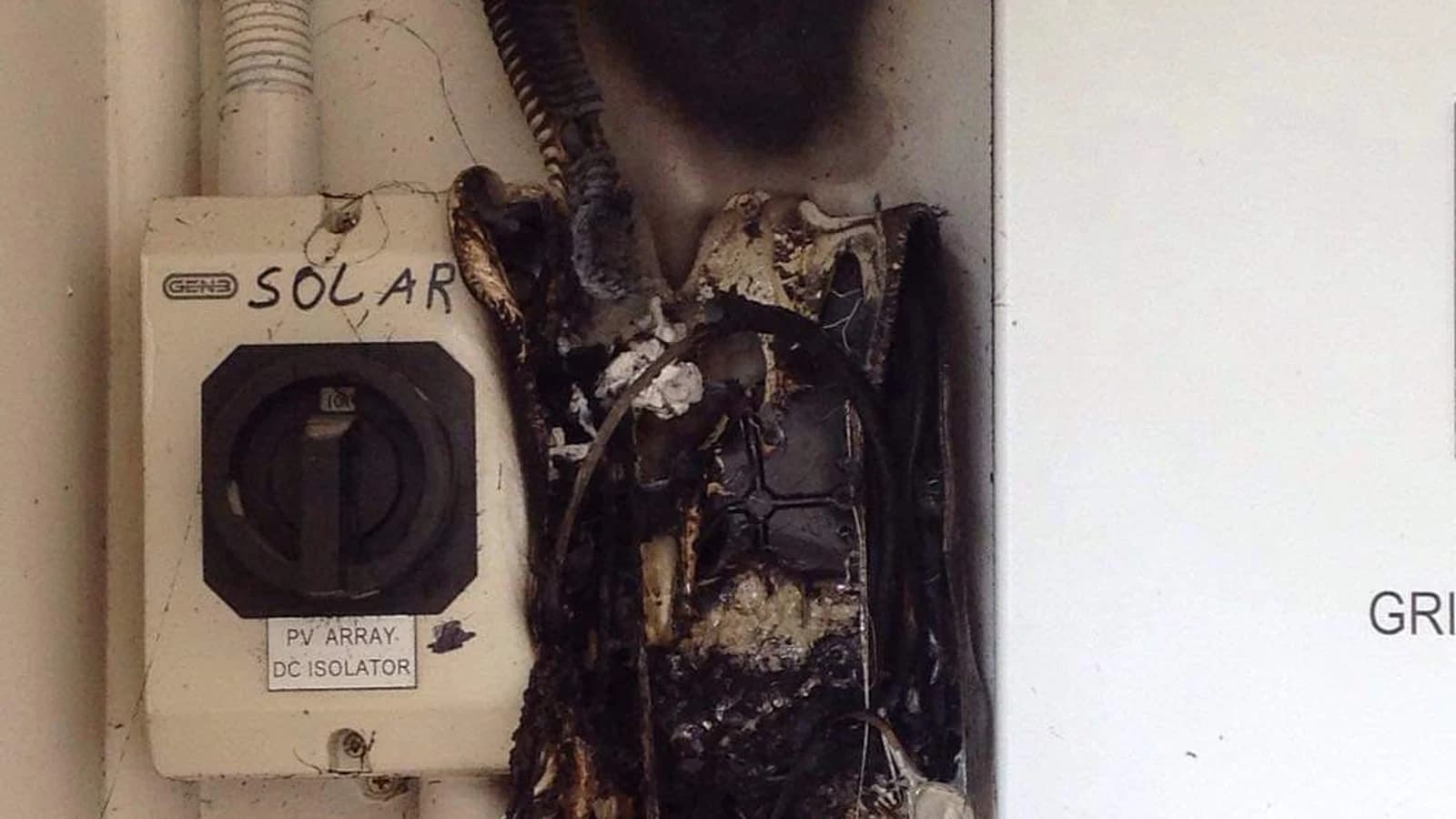
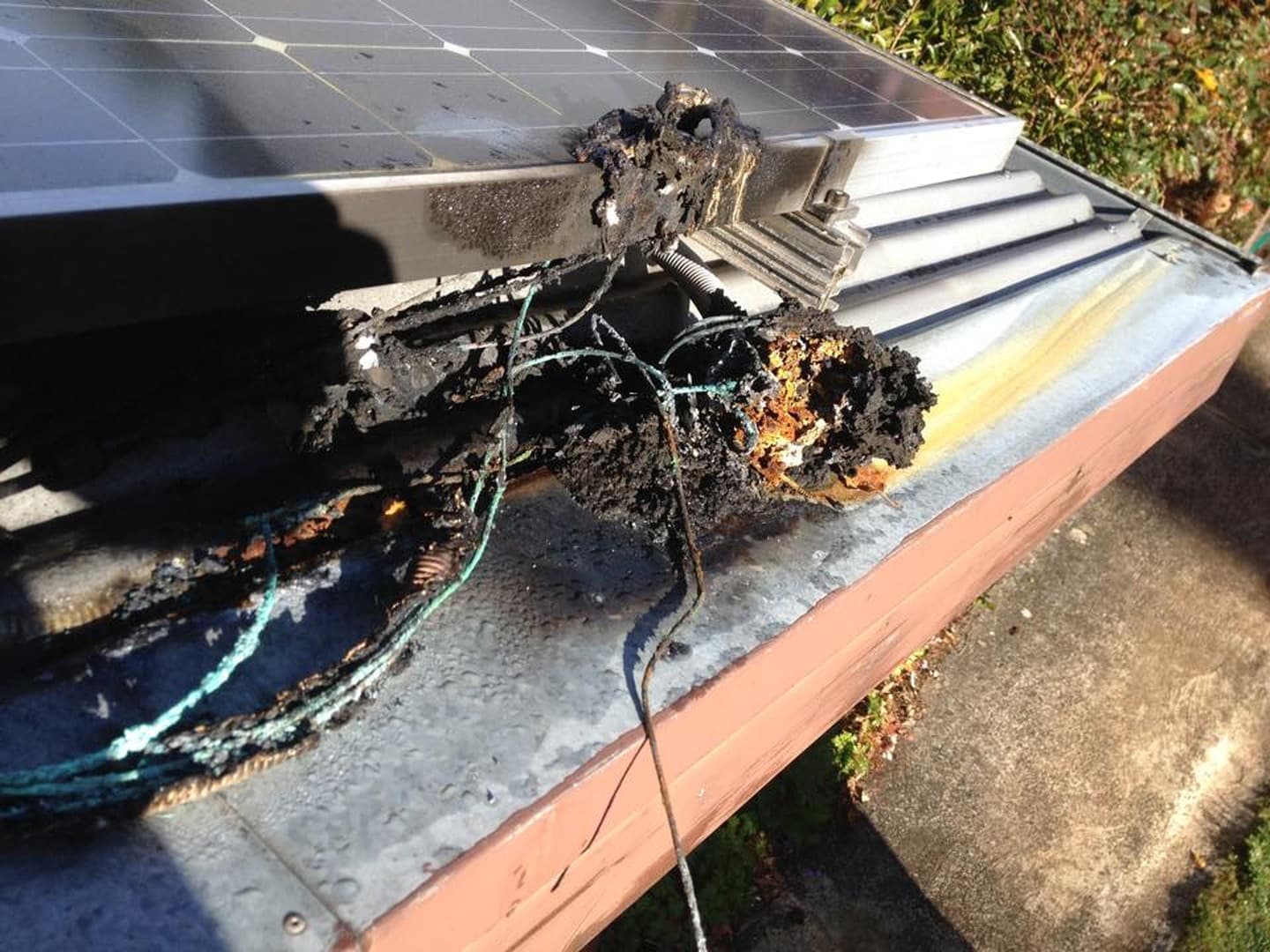
The photo at the top of this page is a solar DC isolator that caught fire on the side of a house. The one further down is a different house, a different isolator, on the roof this time, burnt out at the edge of the array.
Neither homeowner had the faintest idea anything was wrong. From the ground both systems looked completely normal, right up until they did not.
I want to explain what this part does, why it is the component that fails more than any other on an Australian roof, and the one rule about operating it that almost nobody outside the trade knows. It is genuinely the difference between a switch and a fire.
I run a licensed electrical contracting business on the Sunshine Coast (Lic# 92489) and I am an accredited solar installer. Everything below is what we look for on every system we go near.
What a DC isolator is, and why you have more than one
Your solar panels make direct current. Your house runs on alternating current. The inverter sits between the two and converts one into the other.
Everything on the panel side of the inverter is the DC side, and it is the part most people never think about. It is also the part that is live whenever there is daylight, because a solar panel has no off switch. It is not connected to anything you can turn off at the meter box. Sun hits the glass, the panel makes voltage. That is the whole design.
A DC isolator is a switch whose only job is to break that circuit so the system can be worked on safely. In a conventional Australian install there are usually two: one on the roof next to the array, and one at the inverter, often on the wall right beside it. The photo at the top of this article is that second one. You can still read the label on the surviving unit next to the burnt hole: PV ARRAY DC ISOLATOR.
So far, so boring. It is a switch in a plastic box. The interesting part is what happens when you open it at the wrong moment.
Direct current does not let go
Here is the bit that matters, and it is physics rather than opinion.
When you open any switch under load, the current does not stop politely at the moment the contacts part. It jumps the gap. That jump is an arc, and an arc is a channel of ionised air that conducts electricity at thousands of degrees. Every switch in your house does this every time you use it. You never notice, and there is a very specific reason why.
Australian mains power is alternating current at 50 Hz, which means the current reverses direction fifty times a second and therefore passes through zero one hundred times a second. An arc cannot survive a moment of zero current. So an AC arc lights up, gets snuffed out within ten milliseconds by the waveform itself, and the switch opens cleanly. The physics does the hard work for free.
Direct current never crosses zero. There is no moment of nothing. A DC arc, once struck, has no reason to stop and every reason to continue: it is hot, hot air is ionised, ionised air conducts, so it keeps burning and it stretches as the contacts separate. It will happily sustain itself across a growing gap until something runs out. Usually what runs out is the enclosure.
Now add the voltage. A residential solar string typically sits somewhere between about 300 and 600 volts DC in full sun. That is not a spicy tingle. That is more than enough to strike and hold an arc that will melt copper and set fire to a plastic box, which is exactly what you are looking at in the photos on this page.
Never turn the DC isolator off first
This is the practical rule, and it is the one thing I would like every solar owner in the country to know.
Turn the AC off first. Always.
If you open the DC isolator while the system is generating and feeding the inverter, you are asking a switch to interrupt the full output current of your array at several hundred volts DC. That is the worst possible thing you can ask it to do, and it is the moment a tired ten year old isolator turns into the photo at the top of this page.
Kill the AC side first and the picture changes completely. The inverter loses the grid, stops converting, and stops drawing current from the panels within a few seconds. The DC circuit goes to near zero current while staying at voltage. Now when you open the DC isolator, there is barely any current to interrupt, so there is barely any arc. Same switch, same sunshine, entirely different event.
The correct order is not a preference. It is what the inverter manual says, it is what we are trained to do, and it is written on the shutdown procedure label that should be on your switchboard or your inverter.
Shutting the system down
1. Turn off the solar supply main switch (the AC isolator, usually in or beside your switchboard, often labelled Solar Supply Main Switch or Inverter AC Isolator).
2. Wait. Give the inverter time to stop and its internal capacitors time to discharge. A minute is plenty and the screen will normally go dark.
3. Now turn off the DC isolator at the inverter, then the one on the roof if there is one and if it can be reached safely.
Starting back up is the exact reverse: DC on first, then AC last.
And if you do have to operate one
Move the handle fast and decisively, all the way, in one motion. Do not ease it round and do not stop halfway. The faster the contacts separate the less time an arc has to establish itself, and a handle left hovering between on and off is the single worst position a DC isolator can be in.
In an emergency, none of this applies. If you can see smoke, flame or scorching, or you can smell burning plastic, do not go near the switchboard and absolutely do not climb on the roof. Get everyone out, call 000, and tell the crew there is solar on the roof, because it changes how they fight it. The array stays live in daylight no matter what anybody switches off.
Why the rooftop ones fail
The isolator at your inverter usually lives under an eave or inside a garage. The one on your roof does not. It sits in the open, in Queensland, for twenty years.
Think about what that actually means. Full UV all day, which turns plastic enclosures chalky and brittle. Surface temperatures that swing from freezing before dawn to well over 70 degrees by mid afternoon, then back again, roughly seven thousand times a decade. Every one of those cycles expands and contracts the housing, the lid, the seal and the cable glands by a slightly different amount.
Eventually a seal hardens, a gland cracks, a lid warps or a screw backs off, and driving rain finds the gap. Once water is inside a live DC enclosure you get corrosion on the terminals, then tracking across the surfaces, then heat, then carbon, and carbon conducts. From there it is a slow motion short circuit inside a plastic box on a roof, and nobody is watching.
That is the whole story of the photo below. It is not exotic. It is a seal that gave up.
Australia mandated these, then changed its mind
This part surprises people, including a lot of solar owners who assume the rules must have always been sensible.
From 2012, Australian standards required a DC isolator on the roof next to the array on conventional systems. We were the only country in the world with that requirement. The intention was good: give firefighters and technicians a way to break the circuit at the source.
What happened in practice was that we put tens of thousands of plastic switch enclosures out in the weather, and inspection data over the following years made the result clear. Rooftop DC isolators became the single largest source of failures on conventional solar systems in this country, and the largest single cause of solar related fires.
In November 2021 the standard was revised and the rooftop isolator mandate was removed, with alternatives such as a rated disconnection point at the array permitted instead. After a transition period where either version could be applied, the new standard took full effect in 2022.
Two things worth being clear about, because this gets misread constantly. First, this does not mean the isolator on your roof is illegal or has to come off. A system that was compliant when it was installed remains compliant, and removing or altering solar DC equipment is licensed work and a design decision, not a weekend job. Second, it does not mean isolators are bad in themselves. It means putting one on a roof, in the weather, for two decades, turned out to create more risk than it removed.
So how worried should you actually be?
I would rather give you the honest version than scare you into a phone call.
Solar fires are rare. The commonly cited New South Wales figure is that in 2020 fewer than 0.022 percent of all solar systems ever installed in that state had a fire related incident, which is roughly one in four and a half thousand. Your house is far more likely to have a kitchen fire. Solar is a safe technology and I install it for a living because I believe that.
But the composition of that small number is the point. When an Australian solar system does catch fire, the DC isolator is very often the part that started it. More than half of solar related fires in New South Wales have been attributed to them, and state fire services have reported the annual counts climbing as the fleet ages: Victoria went from fifteen isolator fires in one financial year to twenty seven in the next, and the Northern Territory from four to eleven across 2022 and 2023.
That last detail is the one I would pay attention to, because it is about age. The systems installed during the boom under the old mandate are now ten to fourteen years old. Seals do not fail on day one. They fail somewhere around now.
So: low probability, and rising with age, and concentrated almost entirely in one component that is cheap to inspect. That is a very good argument for having someone look at it, and a very poor argument for panicking.
What to look for, and what to do
From the ground, with your feet on the ground, you can check more than you would think. Look at the isolator beside your inverter and at anything you can see of the array from outside.
Signs worth acting on
Brown, yellow or sooty staining on or around an isolator enclosure. Any smell of hot plastic near the inverter. A lid that is cracked, chalky, warped or missing a screw. Water marks, condensation or rust visible inside a clear lid. Buzzing, crackling or sizzling from the enclosure. An inverter that keeps reporting insulation resistance or ground faults, or has quietly stopped producing what it used to.
Any of those, or any burning smell, means stop. Turn off the AC supply if it is safe to reach, leave the DC alone, and get a licensed electrician out. Do not open the enclosure yourself, and do not get on the roof.
The sensible maintenance version
If your system is more than about eight years old and nobody has been on that roof since the day it went in, that is the real problem, and it is not just the isolator. It is also the connectors, the cable ties that have gone brittle in the UV, the leaf litter piled up under the array, and whatever the possums have been chewing.
We fold all of that into our solar panel cleaning and system health check: the panels get washed properly, the litter comes out from under the array, and every isolator, connector, cable run and roof penetration gets inspected while we are up there, with photos and a written report. It is one visit and it covers the whole failure surface rather than one part of it.
If your board is old as well, a thermal imaging scan sees hot joints through the front of a switchboard that looks perfectly normal, live, with nothing shut down. Between the two you have eyes on the parts that fail quietly.
The short version
Your solar array is live every daylight hour and has no off switch. The DC side cannot rely on the waveform to snuff an arc the way the AC side can, so a switch opened under load at several hundred volts DC can strike an arc that sustains itself.
Turn the AC off first, wait for the inverter to stop, then the DC. Never the other way round.
And if there is an isolator sitting on your roof that has been out in the weather since the last solar boom, that is the single most likely thing on your system to fail, and the cheapest thing to have checked. Get someone up there before the weather finds the gap.
Common questions
Should I turn my solar system off at night or in a storm?
Normally there is no need. Your inverter shuts itself down when there is nothing to convert, and it disconnects itself from the grid automatically in an outage. If you do want it off for any reason, use the correct order: AC supply first, wait for the inverter to stop, then the DC isolators. Do not go up on the roof to do it in bad weather.
Can I turn my DC isolator off myself?
You can operate the one at your inverter, provided you turn the AC off first and wait, and provided the enclosure shows no sign of damage, heat or water. If there is any staining, smell, buzzing or visible damage, leave it completely alone and call an electrician. Never open an isolator enclosure, and never operate the one on the roof yourself.
My system is from 2013. Should I have the rooftop isolator removed?
Not as a DIY decision, and not automatically. A system that complied when it was installed is still compliant. What is worth doing is having it inspected, because a twelve year old rooftop enclosure is exactly the age where seals start to let go. If it has degraded, your electrician can talk you through the options, which may include replacing it with current gear or reconfiguring the array to a compliant arrangement that does not need one.
Why is DC more dangerous than AC at the same voltage?
Because of arcs, not shocks. Alternating current passes through zero one hundred times a second at 50 Hz, and an arc cannot survive that, so it self extinguishes almost immediately. Direct current never crosses zero, so once an arc strikes it has nothing stopping it and it will sustain itself and stretch. That is why DC rated switchgear is built completely differently, and why a DC fault turns into a fire more readily.
Does turning everything off make the roof safe to work on?
No, and this is the most important misunderstanding in solar. Isolators break the circuit downstream of the panels. The panels themselves keep generating voltage whenever light hits them, and the cabling between the modules stays live. There is no switch that makes a solar array dead in daylight. That is precisely why this is licensed work.
How often should a solar system be inspected?
Every couple of years is sensible for a system in its first decade, and annually once it is past about ten years old or if it is coastal, rural, under trees or on a shed with heavy dust. The practical way to do it is to bundle it with a clean, so one visit covers the panels, the litter under the array and the whole electrical side at the same time.
Ask us about your place
Tell us what you have and what you are after. You get a written quote from the licensed contractor who does the work, and we reply within 2 hours during business hours. If it is urgent, call 0494 826 740.