What a Lifetime Workmanship Warranty Actually Means

By Daniel Carmont, licensed electrical contractor Lic# 92489
Nuvolt Electrical Solutions · 8 August 2026 · 8 min read
There is a line on every electrical quote that almost nobody reads, and it is the line that decides what happens to you in year seven.
It is the warranty line. It is usually one sentence, it usually contains a number, and the number is usually doing a lot of quiet work. I want to pull that sentence apart, because our own warranty is a lifetime one and I would rather you understood exactly what that does and does not buy you than be pleasantly surprised by the word.
I run a licensed electrical contracting business on the Sunshine Coast (Lic# 92489). Everything below applies to our work. Most of it applies to whoever else you are getting a quote from too.
There are two warranties on every job, and they are not the same
This is the single most common misunderstanding in the trade, and it costs people real money.
When you buy an installed system, a battery, a solar array, a switchboard upgrade, an EV charger, you are buying two separate things. You are buying gear, made in a factory by someone else. And you are buying work, done at your place by a person with a licence.
Each comes with its own warranty, from a different party, for a different length of time.
The manufacturer warrants the gear. If a battery module fails, an inverter throws a fault or a panel degrades faster than its spec sheet allows, that is the maker's problem and the maker's money. Typical terms across the market run 10 to 25 years on solar panels, 5 to 12 years on inverters and around 10 years on batteries, and they vary by model, not just by brand.
The installer warrants the work. The mounting, the penetrations, the terminations, the cable support, the protection devices, the labelling, the testing. Nothing in that list came out of a factory box. It was decided and done on the day, at your house, by a person.
So when a quote says "10 year warranty", the only useful response is a question: on the work, or on the gear? Because if it is on the gear, the installer has warranted you precisely nothing. They have told you what the manufacturer already promised.
So what does lifetime mean?
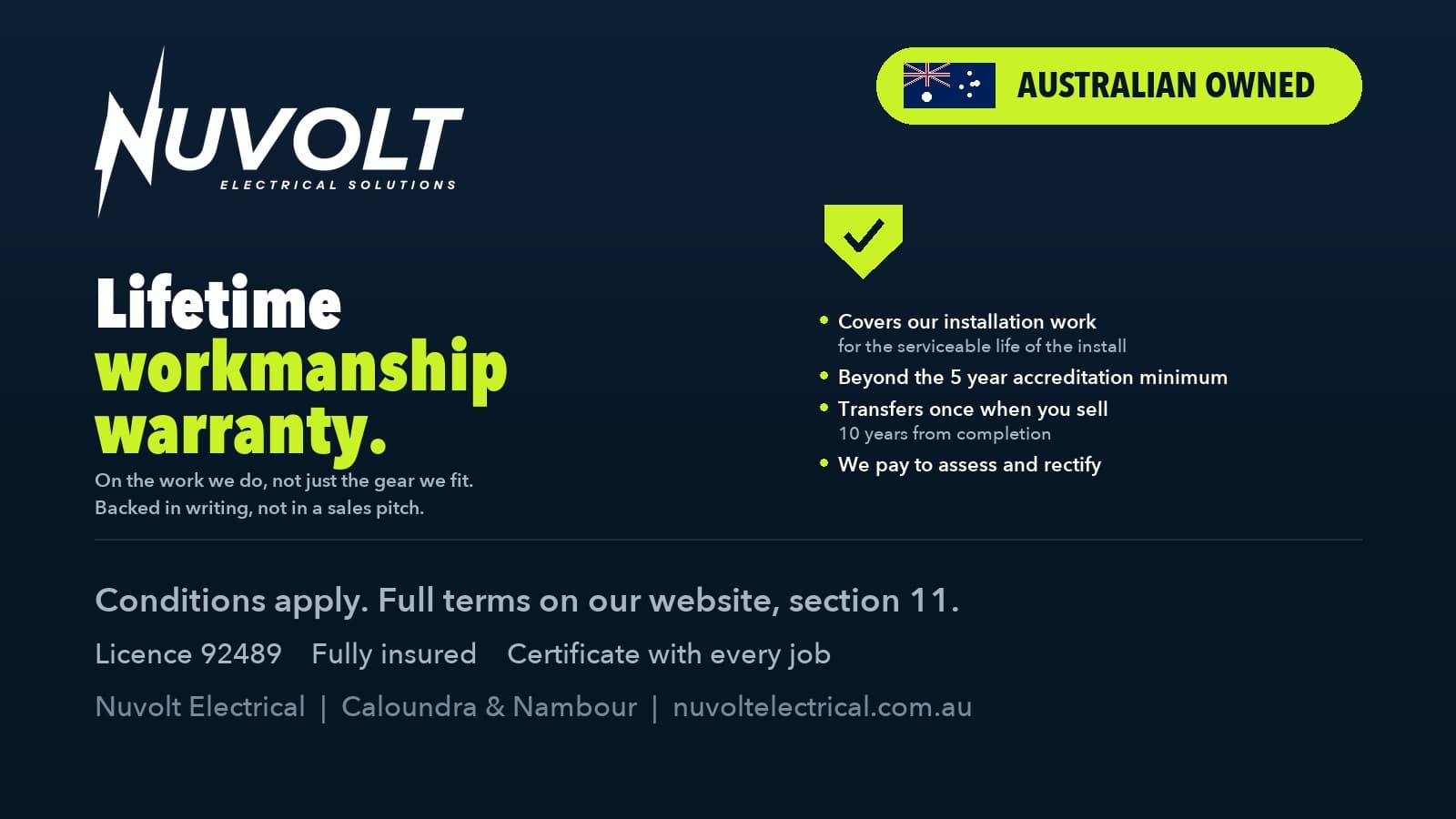
Ours means what it says: installations we perform and invoice are covered for defects in our installation workmanship and labour, from the date of completion, for the serviceable life of the installation. Conditions apply, and they are set out in full in our Terms, section 11.
For context, our SAA accreditation obliges us to warrant our solar and battery workmanship for a minimum of five years. Lifetime is our own choice on top of that, and it applies to our general electrical work as well, not just the accredited stuff.
I want to be straight about why a lifetime workmanship warranty is a thing a small contractor can genuinely offer, because it sounds like marketing and it is not.
Workmanship defects are not random. They are not like a component wearing out. A workmanship defect is a decision that was wrong on the day: a termination that was not torqued properly, a penetration that was not flashed correctly, a cable clipped where it will chafe. Those faults are baked in at handover. Most of them surface early. A small number hide for years and then surface all at once, and roof penetrations are the classic example, which is exactly why we warrant that ours are watertight.
So the real cost of a lifetime workmanship warranty is not the payouts. It is doing the work to a standard where there are not many, and being a business that is still answering the phone in a decade. That is the part that should interest you when you compare quotes.
What it covers
The work. Specifically, defects in our installation workmanship and labour. In practice that means the parts of the job that exist because we made a decision and executed it:
The physical install
Mounting and fixing. Roof penetrations, which we warrant watertight where the roof structure and sheeting were sound when we installed, using proprietary flashings and attachments rather than a tube of silicone and hope. Racking alignment and fastening. Equipment mounted level, supported properly and where it can be serviced.
The electrical work itself
Terminations and connections. Cable selection, routing, support and mechanical protection. Switchboard work, protection device selection and installation, earthing and bonding. Labelling. The testing and certification that goes with it, and the certificate we issue on completion.
Latent defects too
A defect that was not reasonably identifiable at handover is still covered for the full warranty period. That matters, because the workmanship faults that hurt are the ones nobody could see on the day.
What it does not cover, in plain words
This is the part most warranty pages bury. I would rather put it in the middle of the article.
Products. It is not a product warranty. If a piece of equipment fails, that is the manufacturer's warranty, not ours. What we do is manage that claim with the manufacturer on your behalf, which is worth having, because chasing a warranty claim yourself with a distributor is a genuinely miserable way to spend a fortnight.
Fair wear and tear. Corrosion and oxidisation, and on this coast that means salt air. UV and weather degradation. Seals and sealants perishing. Discolouration. Lamps, fuses and detector batteries reaching the end of their life. Time passing is not a defect.
Things that happen to the installation from outside it. Misuse, neglect, accident. Vermin and pests. Vegetation. The building or roof moving and settling. Storm, hail, flood, lightning and fire. Grid surges and brownouts that originate out on the network.
Anything somebody else touched. If another party modifies, repairs, relocates, adds to or otherwise interferes with part of the installation, the warranty is void for that part. This is not territorial. It is that we cannot warrant work we did not do and cannot inspect.
Installations that are not maintained. The system has to be operated and maintained in line with our recommendations and the manufacturer's guidelines, including any scheduled servicing we specify in your project documentation.
Defects you sat on. Suspected defects need to be reported in writing within 14 days of becoming apparent, and the installation must not keep being used in a way that makes the defect worse once it is known.
Unpaid invoices. The warranty applies where our invoice has been paid in full.
And where a claim is accepted, our obligation is to rectify the defective workmanship, or reperform the affected work. It does not extend to consequential or indirect loss. None of that limits your rights under the Australian Consumer Law, which sit underneath every warranty in this country and cannot be signed away.
What happens when you sell the house
Most workmanship warranties in this industry stop dead at settlement. Ours used to as well. We changed it.
The warranty is given to the original customer named on our invoice, and it can now be transferred once to a subsequent owner of the property. Two conditions: the new owner tells us in writing within 60 days of settlement, and the installation has not been modified, repaired or added to by anyone other than us.
A transferred warranty runs for 10 years from the original completion date rather than for the serviceable life of the installation. All the other conditions and exclusions carry across unchanged.
Ten rather than unlimited is deliberate and I will explain the reasoning, because a capped number after an uncapped one looks like a catch. The risk that genuinely belongs to us long after handover is roof penetrations, and ten years covers that honestly for somebody we never met and never contracted with. Beyond that we would be underwriting a house we have not seen in a decade, and a promise a business cannot actually keep is worth less than a smaller one it can.
If you are buying a house with a system we installed, this is worth knowing about within the first 60 days rather than the first 60 months.
How a claim actually works
Tell us in writing within 14 days of the defect becoming apparent. Email hello@nuvoltelectrical.com.au, or post to Nuvolt Electrical Solutions, Unit 19, 20 Brookes Street, Nambour QLD 4560. You can ring 0494 826 740 to get it moving, but follow it up in writing so the 14 day requirement is met.
Include your name, the site address, the invoice number, what the fault is doing, and photos if you have them. Photos save a visit surprisingly often.
We arrange an inspection, and where the fault is our workmanship we rectify it at no cost to you, within a reasonable time.
On the money side: we bear the cost of assessing and rectifying a valid claim, including attending site anywhere in our standard service area. You bear only the cost of contacting us. If we attend and it turns out not to be covered, a product fault, say, or one of the excluded causes above, we tell you before doing any chargeable work, and our standard rates only apply if you then ask us to go ahead.
That last sentence is the one to look for in anybody's warranty. A warranty that is silent on who pays for the truck to turn up is a warranty with a hole in it.
Five questions worth asking any installer
Take these to every quote you are comparing, including ours.
1. Is that warranty on the work or the gear? If the answer wanders, it is on the gear.
2. Where is it written down? A term you cannot read before you sign is not a term. Ask for the document, not the brochure line.
3. Who actually does the rectification? The business you are paying, or a subcontractor they hope is still around? On a warranty claim, subcontracted installs are where responsibility gets murky and the customer ends up refereeing.
4. What voids it? Any honest installer can answer this in about thirty seconds. If the answer is "nothing", either they have not read their own terms or there are none.
5. Does it transfer if I sell? And if so, on what conditions and for how long? The specifics matter more than the yes.
The point of all five is the same. A warranty is a promise about the future made by a business, and the number in it is the least interesting part. What matters is whether the promise is written down, whether it is specific about its own limits, and whether the people making it will still be picking up the phone.
Why we do it this way
We are Australian owned and operated, with a local crew on the Sunshine Coast and no overseas call centres. When you ring about a job we did, you get the people who did it.
That is not a slogan, it is the mechanism. A lifetime workmanship warranty only means something when the person who tightened the terminations is reachable, licensed, insured, and has their name on the certificate. Ours do. It is also why we would rather write the exclusions out in plain English on a public page than let the word lifetime do work it cannot support.
Nuvolt Electrical Solutions does solar, battery storage, EV charging, switchboards and general electrical across South East Queensland. Every installation we perform and invoice carries our lifetime workmanship warranty (conditions apply, see our Terms).
Get a free estimate, ask us a question in the form below, or give us a call. Happy to talk through any of the above before you are a customer.
Nuvolt Electrical Solutions. Australian owned and operated. Local crew on the Sunshine Coast. No overseas call centres.
Common questions
Is a lifetime workmanship warranty really for life?
It covers defects in our installation workmanship and labour from the date of completion for the serviceable life of the installation, subject to the conditions and exclusions in section 11 of our Terms. It is a warranty on our work, not on the equipment, and it is void for any part of the installation that someone other than us has modified, repaired or added to.
What is the difference between a workmanship warranty and a product warranty?
The manufacturer warrants the equipment it made, typically 10 to 25 years for solar panels, 5 to 12 years for inverters and around 10 years for batteries. The installer warrants the work done at your property: mounting, penetrations, terminations, cable routing, switchboard work, testing and certification. They are separate promises from separate parties. As your installer we manage manufacturer warranty claims on your behalf.
Does the warranty transfer if I sell the property?
Yes, once. The new owner must notify us in writing within 60 days of settlement, and the installation must not have been modified, repaired or added to by anyone other than Nuvolt or our authorised representatives. A transferred warranty runs for 10 years from the original completion date rather than for the serviceable life of the installation, and all other conditions and exclusions still apply.
What voids the workmanship warranty?
Modification, repair, relocation or interference with the installation by anyone other than us voids it for that part. It also does not apply where the invoice has not been paid in full, where the installation has not been maintained per our recommendations and the manufacturer's guidelines, or where a suspected defect was not reported in writing within 14 days of becoming apparent. Fair wear and tear, corrosion in salt air, acts of nature and grid events are excluded.
How do I make a warranty claim, and does it cost me anything?
Tell us in writing within 14 days of the defect becoming apparent, by email to hello@nuvoltelectrical.com.au or by post to Unit 19, 20 Brookes Street, Nambour QLD 4560, with your name, site address, invoice number and a description of the fault. We bear the expense of assessing and rectifying a valid claim, including attending site in our standard service area. You bear only the cost of contacting us. If the fault turns out not to be covered, we tell you before any chargeable work starts.
Ask us about your place
Tell us what you have and what you are after. You get a written quote from the licensed contractor who does the work, and we reply within 2 hours during business hours. If it is urgent, call 0494 826 740.