Hybrid inverter or AC coupled retrofit: how to add a battery to solar you already have

By Daniel Carmont, licensed electrical contractor Lic# 92489
Nuvolt Electrical Solutions · 26 August 2026 · 9 min read
Every household that already has solar and wants a battery faces the same fork, and most battery quotes pick one branch of it without telling you the other exists. Either your existing solar inverter comes off the wall and a hybrid inverter goes up in its place, with the panels and the battery both connected to it, or your inverter stays exactly where it is and a battery is added beside it on the AC side of the house.
I am a licensed electrical contractor on the Sunshine Coast (Lic# 92489) and an accredited solar and battery installer. I do both kinds of job. One of them is more profitable for me than the other, which is exactly why I think you should understand the difference before you sign anything.
The two ways to add a battery to solar you already own
A battery is direct current. Your panels make direct current. Your house runs on alternating current. Somewhere in the system a box has to convert between the two, and where that box sits is the whole difference between the two designs.
In the hybrid design, also called DC coupled, one new inverter does everything: it takes the panels on one side, the battery on another, and the house and grid on the third. Your existing solar inverter is removed. In the AC coupled design, your existing solar inverter keeps converting the panels' output to AC exactly as it does today, and a second unit, a battery inverter or an all in one AC battery, sits on the house wiring and charges from that AC, converting it back to DC to store and to AC again to use.
Both are legitimate, both are eligible for the federal battery discount, both are installed on the Coast every week. They are not interchangeable, and which one suits your house depends on things a phone quote cannot see.
How each one actually works, and where the energy is lost
The difference is easiest to follow by counting conversions.
The hybrid path
Sun hits the panels, DC flows into the hybrid inverter, and the inverter sends it one of three ways: DC straight into the battery, AC into the house, or AC out to the grid. Charging the battery from solar is a single DC to DC step, which is efficient. Most hybrids sold here include an emergency supply output for backup, so keeping some circuits alive in a blackout is a feature of the inverter rather than an extra box, though the changeover behaviour and how much it will run varies a lot by model. Everything reports to one app. The old inverter goes in the recycling.
The AC coupled path
Sun hits the panels, DC flows into your existing inverter, which converts it to AC and pushes it onto the house wiring. The battery inverter takes that AC, converts it to DC to charge the battery, and later converts it back to AC to run the house. That is two extra conversions for every kilowatt hour stored, and each one loses a few percent, so the round trip is less efficient than the hybrid's. In exchange, nothing about your existing solar changes: no new inverter, no disturbing the roof wiring, no reprogramming.
The catch most people do not hear about is backup. An AC coupled battery can only run the house in a blackout if the battery inverter is built to form its own little grid, and it can only recharge from your panels during that blackout if it can also control your existing solar inverter, which it does by nudging the frequency to throttle it. Some combinations do this well. Many older solar inverters cannot be controlled that way, so the battery runs down and the panels sit idle until the grid returns. If backup matters to you, this single question decides more than anything else on this page.
When AC coupled is the right answer, including when it is the cheaper job for you
I will say this plainly because a lot of installers will not: sometimes the right answer is to leave your inverter alone, and that is the less profitable job for me.
Your inverter is young and good. If it is under about five years old, from a manufacturer with real Australian support and still under warranty, replacing it with a hybrid means throwing away a working asset you paid for. An AC coupled battery keeps it, and the small efficiency penalty is the price of not buying an inverter twice.
You are on the 44 cent Solar Bonus Scheme. The scheme's conditions are specific: you keep the tariff if the inverter is replaced with one of the same or smaller capacity, you lose it if inverter capacity is increased, and a battery is allowed provided it is only used when the solar system is not operating, or it has its own separate connection. A hybrid replacement is almost always a bigger inverter than the 2011 original, and it ends the tariff. How a particular battery configuration is treated under those conditions is a question to settle with Energex and your retailer in writing before you sign, not after. On a house that exports a lot, the tariff is worth real money until it expires on 1 July 2028, and the honest design conversation is about how to add storage without breaching the conditions, or about timing.
The house does not want the disruption. A hybrid swap touches the roof wiring, the inverter position and the switchboard in one visit. On some houses, a heritage roof, a difficult inverter location, a job that has to be done live around a home business, the AC coupled path is simply the smaller intervention.
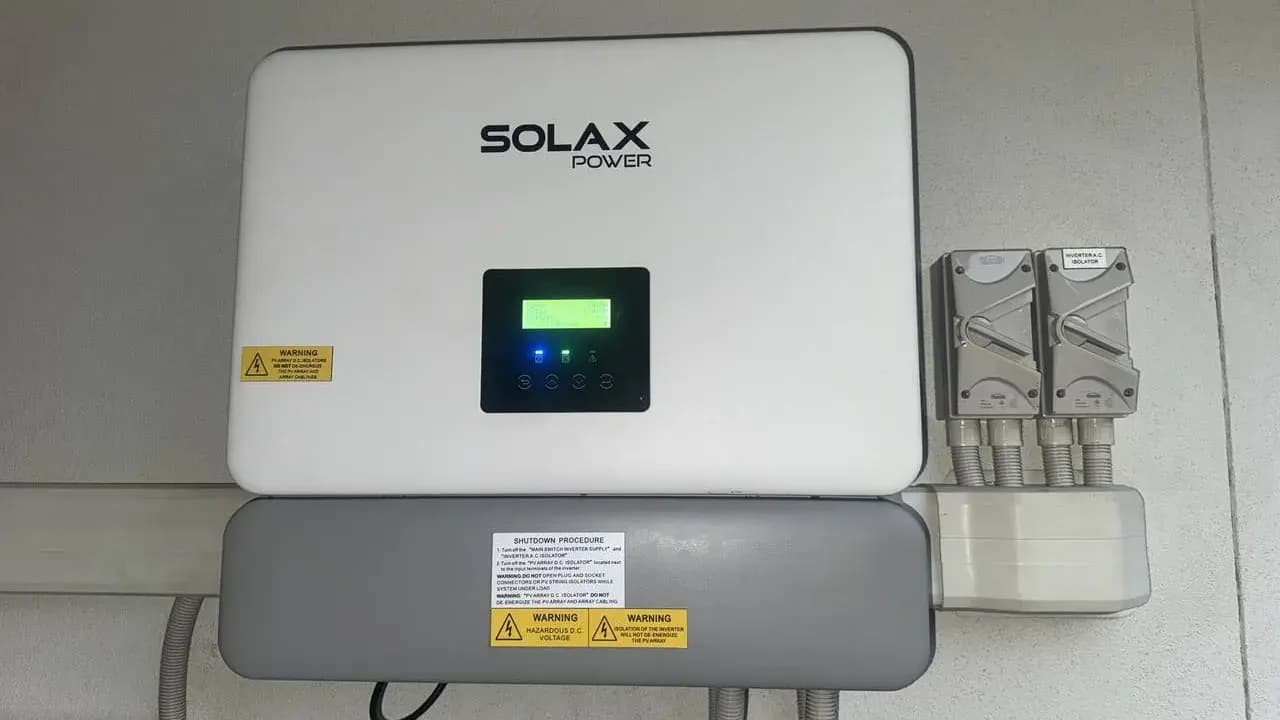
SolaX build AC coupled retrofit units for exactly this case, which is one reason they are in our range; the details are on the SolaX page and in the SolaX battery review.
When the hybrid swap is right
Your inverter is old or unsupported. Eight years or more, out of warranty, a brand that has left the Australian market, or already showing the afternoon shutdowns and morning faults I describe in what fails on a solar system after ten years. Replacing it with a hybrid turns a repair bill into the foundation of a modern system, and it is the most common battery job I do.
You want backup that actually works. A hybrid with a proper emergency supply output, or a system with a built in bypass, keeps the panels charging the battery during an outage because one box controls both. That is the backup most people picture when they say the word. What it can run, and for how long, is a load and switchboard question, and I cover it in whole home versus essential circuit backup.
You want more panels. A 2014 system was sized for the tariff and the budget of 2014. If you are adding a battery, you almost always want more generation to fill it, and a hybrid swap is the natural moment to add panels, which also earns the rooftop solar certificates on the new panels. An AC coupled battery adds no panels and earns no solar certificates; the federal battery discount applies either way.
Inverter capacity on your connection. Energex counts every inverter on the property against the same limit, 10 kilowatts on a single phase supply and 30 kilowatts across three phase. An existing 5 kilowatt solar inverter plus a 5 kilowatt battery inverter uses the whole single phase allowance, and a bigger existing inverter can leave no room for a separate battery inverter at all. A hybrid is one box, so on a lot of single phase houses it is the only design that fits inside the limit with any room to grow.
Three phase houses. If you have three phase supply and a single phase solar inverter on one leg, the hybrid swap is the moment to move to a three phase inverter that balances the house properly. Our three phase systems are built around that case.
What both paths have in common: Energex, the rebate, the switchboard
Energex. Any change to the inverter on your connection, and any change to battery capacity, is a connection application lodged by your electrician through the Energex Electrical Partners Portal before the work is done. That is true for a hybrid swap and for an AC coupled battery inverter alike. A quote that does not mention the application is missing a step.
The federal battery discount. The Cheaper Home Batteries Program applies to a battery installed with a new or an existing solar system, so both designs qualify, and the discount is calculated on the battery's usable capacity, not the number on the box. I explain the structure, without quoting a figure that will go stale, in the federal battery rebate explained. What you should know for this decision: it steps down on 1 January 2027, and it does not care which coupling you choose.
The switchboard. Both designs need space on the board, protection for the new circuits, and, if backup is included, the changeover arrangement and the circuit protection that goes with it. On a 1990s board that is the hidden cost that makes two battery quotes differ by thousands, and it is the same cost whichever coupling you pick. What a switchboard upgrade costs on the Sunshine Coast has the general ranges.
Warranty registration and usable capacity. Whichever path you take, the battery warranty is generally conditional on registration within a set window after installation, and the capacity you should be comparing is usable, not nominal, because that is what runs your house and what the discount is paid on. What size home battery you actually need is the sizing guide.
Getting it quoted both ways: the questions to ask
Ask any battery installer these six things and you will learn more from the answers than from the price.
Which coupling is this quote, and why that one for my house? What is the total inverter capacity on my connection after the job, and does it fit the Energex limit? If the power goes out, will the panels keep charging the battery, and what exactly will it run? What happens to my existing inverter and its warranty? What is the usable capacity of the battery, not the nominal? And has the Energex application been included?
An installer who can only answer for one design has only priced one design. On the right house that is fine; on the wrong one it is an expensive way to find out there was a choice. I would rather price both and show you the difference. That is what the $299 solar and battery design visit is for: your existing system tested, the roof, the board and the metering checked, and a written design you keep and a locked in fixed price within 3 business days, credited back in full off the installation if you go ahead within 30 days of the visit. If you would rather start at no cost, a free estimate comes back within 1 business day of receiving your photos, confirmed from them or a $299 design visit if one is needed. We can't estimate without photos.
Common questions
Can I add a battery to my existing solar system without replacing the inverter?
Yes. An AC coupled battery sits on the house wiring beside your existing solar inverter and charges from its AC output, so the inverter stays. It costs a few percent in extra conversion losses, it adds no panels, and it only provides backup if the battery inverter can form its own grid and control your existing solar inverter during an outage. It is the right answer when your inverter is young and well supported, and often when you are on the 44 cent tariff.
What is the difference between a hybrid inverter and an AC coupled battery?
A hybrid inverter replaces your solar inverter and connects the panels, the battery and the house through one box, so solar charges the battery in a single DC step and backup is built into the inverter. An AC coupled battery keeps your existing inverter and adds a second unit that converts the house's AC to DC to charge, and back again to use, which is less efficient but leaves the existing system untouched.
Will adding a battery affect my 44 cent Solar Bonus Scheme feed in tariff in Queensland?
It can. The scheme's conditions keep the tariff if the inverter is replaced with one of the same or smaller capacity and end it if inverter capacity is increased; a battery is permitted provided it is only used when the solar system is not operating, or it has a separate connection. A hybrid replacement is usually a larger inverter and ends the tariff. Confirm how your proposed configuration is treated with Energex and your retailer in writing before signing. The scheme expires on 1 July 2028.
Do I need Energex approval to add a battery to my solar?
Yes. Any change to the inverter on your connection, and any change to battery capacity, requires a connection application lodged by your electrician through the Energex Electrical Partners Portal before installation, for both hybrid replacements and AC coupled battery inverters. Energex also counts every inverter on the property against the same capacity limit, 10 kilowatts on single phase and 30 kilowatts on three phase.
Does the federal battery rebate apply to a retrofit on existing solar?
Yes. The Cheaper Home Batteries Program applies to a battery installed with a new or an existing solar system, whichever coupling is used, and the discount is calculated on usable capacity. It steps down on 1 January 2027. Adding panels at the same time earns the separate rooftop solar certificates on the new panels; an AC coupled battery on its own does not.
Will an AC coupled battery run my house in a blackout?
Only if the battery inverter is designed to form its own grid when the network drops, and only with your panels contributing if it can also control your existing solar inverter by shifting frequency. Many older solar inverters cannot be controlled that way, so the battery runs down while the panels sit idle. If backup matters, ask the installer that exact question, and consider a hybrid or a system with a built in bypass, where one box controls both.
Ask us about your place
Tell us what you have and what you are after. You get a written quote from the licensed contractor who does the work, and we reply within 2 hours during business hours. If it is urgent, call 0494 826 740.