Fox ESS CQ7 battery review, from the people who install it

By Daniel Carmont, licensed electrical contractor Lic# 92489
Nuvolt Electrical Solutions · 22 August 2026 · Updated 15 September 2026 · 8 min read
Most battery reviews online are written from a spec sheet by somebody who has never carried one up a driveway. They tell you the capacity, they list the warranty term, they give it four and a half stars, and you finish reading knowing nothing you did not already know.
This one is different, because we fit these. I run a licensed electrical contracting business on the Sunshine Coast (Lic# 92489), I am an accredited installer, and the Fox ESS CQ7 is one of the batteries we put into Queensland homes regularly.
So this is the version I would give you standing in your garage: what the thing actually is, what it is like to live with, the parts that are genuinely good, and the parts I would want you to understand before you sign anything.
What a CQ7 actually is
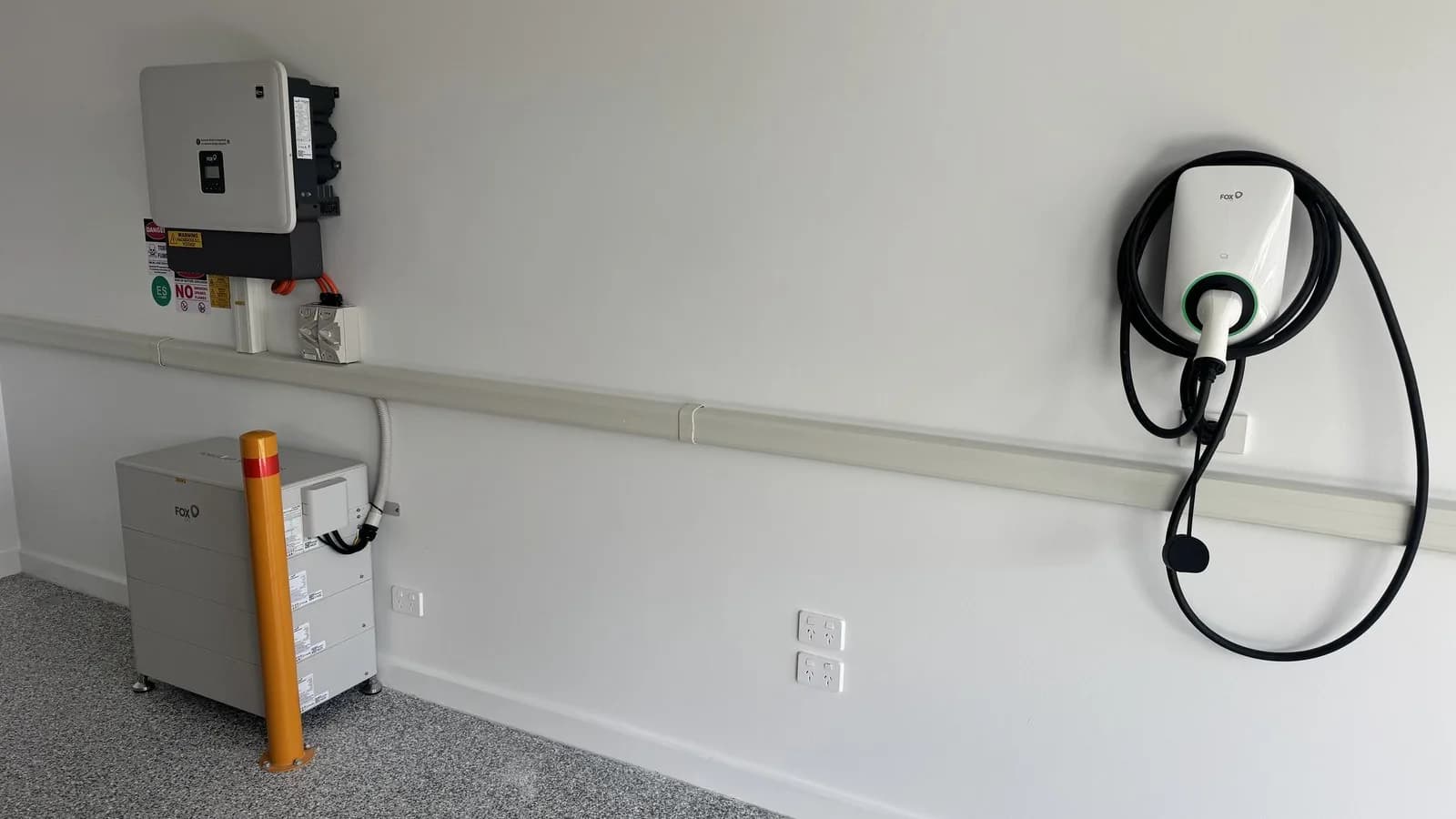
The CQ7 is a floor standing, stackable battery module. You do not buy one big box. You buy a number of identical modules that stack vertically on a base, and the stack behaves as a single battery.
Each module holds a little under 7 kWh of usable capacity. That word usable matters, and it is the number to hold onto: a lot of marketing quotes nominal capacity, which is the number before you subtract the portion the battery management system keeps in reserve to protect cell life. Usable is what actually runs your house.
The stack is built as one master module plus however many slaves you add. In practice that means a six module stack lands a bit under 42 kWh usable and a seven module stack a bit under 49 kWh. You can start smaller and add modules later, which is genuinely useful, and I will come back to the conditions on that.
Chemistry is lithium iron phosphate, as it is for almost everything in this class now. That is the right choice for an Australian garage: it runs cooler, it tolerates heat better than the older chemistries, and it is the reason these installs are as unremarkable as they are.
What it is like to install
Three things stand out from doing these for real, and none of them appear in a brochure.
They are heavy, and they are floor standing. This is not a slim wall unit you hang between two studs. Each module is a substantial lift, and a tall stack needs a flat, solid, dry footprint that will still be there in fifteen years. In a lot of Queensland homes the honest answer is the garage, not the side of the house. If somebody is quoting you a big stack without having looked at where it will physically stand, that is a gap in the quote.
The stacking is the good part. Because modules are identical and repeat, the install is clean and the labelling is clean, and adding capacity later is a real option rather than a sales line. Compare that with a sealed single box battery, where wanting more later means a second complete system.
The surrounding gear is where the work actually is. The battery is the simple bit. The hybrid inverter, the isolation, the switchboard work and the labelling around it are the parts that take the day and take the skill. Two quotes for the same battery can differ by thousands purely on what is happening at your board, and that difference is usually real rather than padding.
Where it suits, and where it does not
It suits you if you want a large amount of storage and a path to add more. The modular stack is its strongest argument. Households with high evening use, a pool, ducted air conditioning, an electric vehicle, or a plan to get off gas are exactly the case it is built for.
It suits you if the install location is a garage or a plant room with real floor space, and you would rather have one tall tidy stack than several wall units competing for wall.
It suits you less if you want a small battery in a tight spot. If you are after something modest on a narrow side wall, a compact wall mounted unit is a better physical fit and you should not be talked out of it. Bigger is not automatically better, and the next article on this site goes through why the rebate itself stops rewarding size past a certain point.
It also suits you less if nobody is going to look after it. Any battery is a monitored asset. If the system is never registered, never monitored and never looked at again, you have bought an expensive box. That applies to every brand, not this one.
Backup is a separate decision, and it is not instant
This is the single biggest misunderstanding I meet, and it is worth being blunt about.
A battery on its own does not keep your lights on in a blackout. Storing energy and running your house independently of the grid are two different jobs. Backup needs additional equipment that physically disconnects you from the network before it reenergises your circuits, because feeding power back into a dead street would be dangerous for the crew working on it.
That equipment is scoped and priced separately for good reason: every switchboard is different, and which circuits you want alive in an outage is a decision about your house, not a product feature. Whole home backup and essential circuit backup are genuinely different builds, and we wrote a whole article comparing the two.
And when the power does go out, the changeover is not always instant, and the difference between systems is large. Some hybrid inverters transfer in under ten milliseconds, which is fast enough that nothing in the house notices. Others take a couple of seconds while the system detects the outage, disconnects and reenergises. Your lights and your fridge will not care either way. A desktop computer without a small UPS will care very much about the difference.
So do not accept "it has backup" as an answer. Ask for the changeover time in milliseconds or seconds, and ask whether it covers the whole house or selected circuits. Both numbers are published for every system worth buying, and an installer who cannot tell you them has not read the manual.
The warranty step almost nobody is told about
Here is the detail I would most like every battery owner in the country to know, and it applies across brands.
A manufacturer's battery warranty is generally conditional on the system being registered with the manufacturer after installation. Not the receipt in your drawer. A registration, made against the serial numbers, within the window the manufacturer sets.
If that step is skipped, the warranty can be void. You will not find out on the day. You will find out in year six, when you have a fault, and the answer is that there is no record of your system existing.
So when your install is finished, ask your installer one question: has this system been registered with the manufacturer, and can I have confirmation of that in writing? A good installer will already have done it and will send it without hesitation. If the question causes friction, that tells you something useful before you need the warranty rather than after.
The same goes for the workmanship warranty on the labour, which is a separate thing entirely from the manufacturer's cover on the hardware. We explain how ours works in what a lifetime workmanship warranty actually means.
How it interacts with the federal battery discount
Two points here, because they change the maths on a CQ7 stack specifically.
A battery retrofit earns no solar certificates. The federal battery discount and the older rooftop solar discount are different schemes. Adding storage to an existing solar system creates battery certificates only. You are not getting a second bite of the panel discount unless panels are also going on.
The discount does not scale evenly with size. It is tiered on usable capacity, and the value per kilowatt hour falls sharply as the stack grows. That is the honest counterweight to everything good I said about the modular stack above: the modules keep adding storage, but past a point they stop adding much discount. If your interest in a big stack is value per kilowatt hour rather than sheer capacity, read what size home battery you actually need before you decide.
One timing note that catches people out: the discount is set by the date your system is installed, not the date you accepted a quote. The rate steps down on 1 January 2027 and then every six months after that. If your install slips across one of those dates, your discount changes with it, so a quote near a step down is worth pinning down.
So would I put one in
Yes, for the right house. If you want serious storage, you have the floor space, and you like the idea of adding capacity later rather than replacing a system, the CQ7 is a sound piece of equipment and it installs cleanly.
I would push back if you are chasing the biggest number for its own sake. The stack will happily grow past the point where the rebate rewards it, and a battery sized around your actual evening use is almost always the better buy.
And whichever brand you land on, get the backup scoped properly, get the registration confirmed in writing, and make sure the quote itemises what is happening at your switchboard. Those three things matter more to how the next ten years go than the badge on the front of the battery.
Common questions
How much usable capacity does one Fox ESS CQ7 module hold?
A little under 7 kWh usable per module. Usable is the figure that matters, because it is what actually runs your house after the battery management system holds back a reserve to protect cell life. A six module stack lands a bit under 42 kWh usable and a seven module stack a bit under 49 kWh.
Can I add more CQ7 modules later?
Yes, that is one of the genuine strengths of a modular stack, and it is a real option rather than a sales line. It is worth confirming at quote stage that the inverter, the physical footprint and the switchboard work have been specified with the larger future stack in mind, because those are the parts that constrain expansion later.
Will a Fox ESS battery keep my house running in a blackout?
Only if backup equipment is installed alongside it. A battery on its own stores energy but does not run your house independently of the grid. Backup requires additional gear that safely disconnects you from the network first, it is scoped separately because every switchboard differs, and the changeover time varies a lot between systems, from under ten milliseconds on some hybrid inverters to a couple of seconds on others. Ask for the figure rather than accepting "it has backup".
Does my battery warranty need to be registered?
Generally yes, and this applies across brands. Manufacturer battery warranties are usually conditional on the system being registered against its serial numbers within a set window after installation. Ask your installer to confirm in writing that it has been done. A missed registration typically only comes to light years later when a claim is made.
Does adding a battery to my existing solar earn the solar rebate too?
No. The federal battery discount and the rooftop solar discount are separate schemes. A battery retrofit onto an existing system creates battery certificates only. Solar certificates apply only if new panels are being installed as well.
Ask us about your place
Tell us what you have and what you are after. You get a written quote from the licensed contractor who does the work, and we reply within 2 hours during business hours. If it is urgent, call 0494 826 740.