We rebuilt our solar calculator. Here is what most solar calculators get wrong.

By Daniel Carmont, licensed electrical contractor Lic# 92489
Nuvolt Electrical Solutions · 4 November 2026 · 7 min read
Most solar calculators exist to make a system look good. Put a number in, get a bill saving out, book the sales call. I have never wanted ours to work like that, which is why it has only ever dealt in energy: kilowatt hours in, kilowatt hours out, and not a dollar anywhere, because what you save depends on a tariff I do not control.
This week we rebuilt it. Not because the maths was wrong, but because it did not know three things that decide every real quote I write on the Sunshine Coast. If you have used a calculator before and the quote that followed looked nothing like it, one of these three is probably why.
You can open it at nuvoltelectrical.com.au/solar-calculator and follow along.
Why I rebuilt a calculator that was already honest
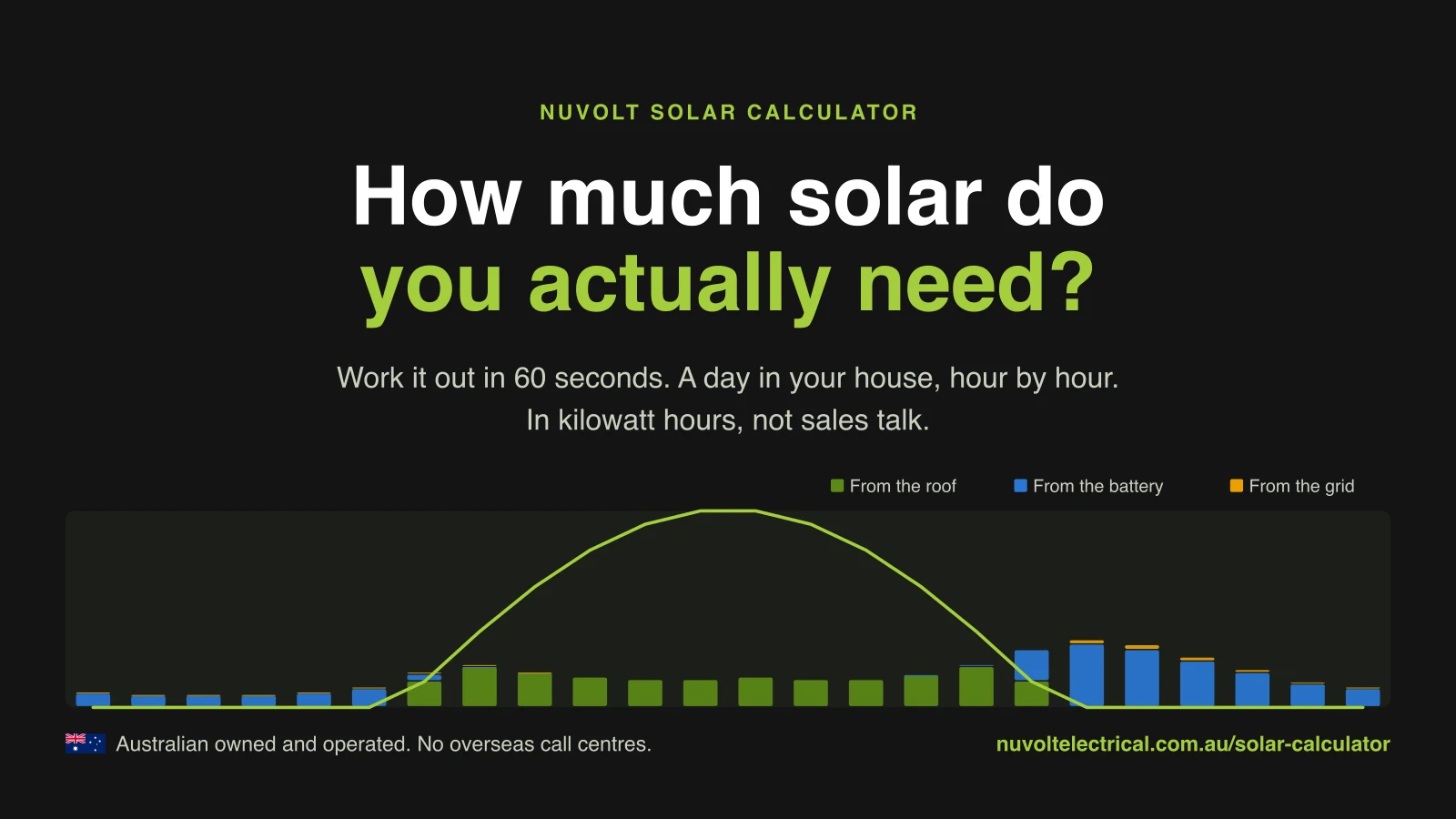
The old version did the hard part properly. It ran a day in your house hour by hour, with the sun coming up and going down at Sunshine Coast times, your household's use shaped the way a real Queensland home uses power, and a battery that only ever charged from your own surplus. It also ran the day four times over, at four levels of sunshine, and blended them by how often each turns up here. That last bit matters more than anything else on this page, so it gets its own section below.
What it did not know was what sits behind your meter box. It let you draw a battery that was five percent smaller than the one you thought you had, an array a single phase home could never connect, and a midday surplus the network would never let you sell. Those are not rounding errors. They are the difference between a calculator and a quote.
Mistake one: the average day that never empties the battery
This is the trick most calculators play, and I do not think most of them even know they are playing it. Run one average day and almost any decent system covers a hundred percent of a house, because an average day never runs the battery flat and never floods the roof with more than it can store.
Real years are not made of average days. They are made of bright ones where you export a pile you cannot store, and wet weeks where you buy power in. Blend those honestly and the same system that looked like a hundred percent lands around ninety five. That is the number we show, and it is the number you will actually see on your bill.
Mistake two: kilowatt hours you cannot use
Batteries get sold on a headline figure and delivered on a usable one. A Fox ESS CQ7 module is 6.96 kWh usable. A Power Cube EQ5500 module is 5.46 kWh and all of it usable. A GoodWe ESA module is 9 kWh on the box and 8.85 kWh usable. Every Nuvolt quote states the usable figure, because that is the energy you get back after dark.
The old calculator quietly took five percent off whatever you set the battery slider to, which made sense for a generic battery and no sense for the ones we actually fit. The slider now means usable kilowatt hours, the figure on the product sheet, and the model uses all of it. Set it to 14 and you are modelling the 13.9 kWh a two module CQ7 stack really holds.
Mistake three: a system your supply cannot connect
Most Sunshine Coast homes are single phase, and a single phase connection in Energex country takes 10 kW of inverter in total, counting every inverter on the property. Three phase takes 30 kW. That one fact caps how fast a battery can charge and discharge, how big an array makes sense, and whether your existing solar inverter stays on the wall when a battery goes in.
The calculator now asks. Pick single or three phase and the array slider, the battery power and the limits below all follow. On single phase it will also tell you, in words, that an array past about 13.3 kW only makes sense with a battery in the system, because without one the inverter cannot use it. On the three phase system pages the embedded calculator opens on three phase already.
If you are not sure which you have, look at the main switch in your switchboard: one pole is single phase, three poles is three phase. Or leave it on single phase and we confirm it from your photos when you enquire.
Mistake four: pretending you can sell everything you export
Here is the one almost no calculator applies, and it is the one that most flatters a big array with no battery. Energex limits how much a home can push back into the grid: 5 kW on single phase and 15 kW on three phase, and every system we install is set to exactly that. On a bright day a large array makes more than the house is using and more than the limit lets out, so the inverter throttles the panels and that energy is simply never made.
The old model exported all of it and counted it as a win. The new one clips it, the way your inverter will, and tells you how much. Try a 20 kW array on a single phase home with no battery and watch the sent back to the grid tile: around 29 kWh a day is clipped at midday. Add a battery and most of that goes into storage instead of being thrown away. That is the honest case for a battery on a big roof, and it has nothing to do with a sales target.
What Size it for me actually does
Sliders are good once you know roughly where to put them. Most people do not, so there is now a button that picks a starting point from your own numbers, and it works the same way I explain sizing on a site visit.
The panels: about half a kilowatt of panels for every kilowatt hour your home uses in a day, a little more if your roof does not face north, snapped to whole panels and capped at what your supply can take. A home on 20 kWh a day lands near 10 kW, which is 21 panels at 475 W.
The battery: what that array still cannot cover on an annual average day, delivered through the battery's losses, with a quarter on top for the cloudy days an average day hides. It is then bounded by what the roof actually has spare to put into it, because a battery your solar cannot fill is just a box in the garage. Under five kilowatt hours of real use and it tells you a battery would barely be used, and starts you at none.
Then it says in one sentence what it picked and why, and you move the sliders from there. Nothing it chooses is a quote. It is the same arithmetic I would do on the back of your bill.
Three Sunshine Coast homes, run through it
All three on a north facing roof, averaged across the year, with someone in and out of the house during the day unless noted.
A couple on 12 kWh a day, nobody home in the day. Size it for me lands on 13 panels, about 6.2 kW, and a 10 kWh usable battery, covering about 96 percent of their power. Nothing is clipped, because the roof is modest and the battery catches the surplus.
A family on 20 kWh a day. 21 panels, just under 10 kW, and a 14 kWh battery: about 96 percent of their power, with around 2 kWh a day clipped at the export limit on the brightest days. A two module CQ7 stack is 13.9 kWh, which is why so many of our quotes land there.
A big house on 40 kWh a day, home all day, single phase. This is the one that surprises people. The array caps at 20 kW because the inverter caps at 10 kW, the battery lands at 23 kWh, coverage is still about 96 percent, and about 18 kWh a day is clipped. That clipping is the single phase ceiling showing itself, and it is the reason a home like this is often a conversation about a bigger battery, a three phase upgrade, or accepting that the roof will do less than it could.
From a slider to a real battery
A number on a slider is not a product, so under the results the calculator now shows the nearest real stacks from the brands we install: Fox ESS CQ7 modules, the new Fox ESS Power Cube on single phase, GoodWe ESA, SAJ EK90 and Sigenergy SigenStor, each as a module count and its usable capacity, linking to our page on that system. Set 27 kWh and you will see four CQ7 modules at 27.8 kWh, five Power Cube modules at 27.3 kWh and three GoodWe modules at 26.6 kWh. That is the same shortlist I would put in front of you.
The same model runs inside NV, the assistant on our website, so a size guide you get in the chat and the calculator you open from it never disagree. One model, two doors.
What it still cannot know
The tree over your western roof. The shed that shades you at three in the afternoon in June. Whether your switchboard has room for the protection a battery needs. Whether your particular connection was approved for less export than the usual limit. Every one of those moves a real number, and not one of them fits in a slider.
So treat the calculator as what it is: the honest sizing conversation, had before anyone has driven out. When you are ready for the real numbers, send your bill and a few photos for a free estimate, or book a solar and battery design visit and have the design done on your roof before you decide.
Common questions
Why does the Nuvolt solar calculator not show dollars?
Because any dollar figure would be a guess dressed up as a fact. What you save depends on your retailer, your tariff and your feed in rate, none of which a slider can know. Energy we can model honestly, hour by hour, and you can put your own tariff against it or we do it with you against your actual bill when we quote.
What is the export limit and why does it matter for solar sizing?
Energex limits how much power a home can send back to the grid: 5 kW on a single phase connection and 15 kW on three phase. On a bright day a large array makes more than the house uses and more than the limit allows, so the inverter throttles the panels and that energy is never made. The calculator applies the limit and shows how much a setup clips, which is the honest reason a battery earns its keep on a big roof.
Does it matter whether my home is single or three phase?
Yes. A single phase home takes up to 10 kW of inverter, so a battery charges and discharges at no more than that and an array past about 13.3 kW only makes sense with a battery. Three phase takes 30 kW of inverter and a 15 kW export limit. Most Sunshine Coast homes are single phase; the main switch in your switchboard has one pole on single phase and three on three phase.
Is the battery size in the calculator usable or nominal capacity?
Usable, the figure on the product sheet and on every Nuvolt quote. A Fox ESS CQ7 module is 6.96 kWh usable, a Fox ESS Power Cube EQ5500 module is 5.46 kWh and all usable, and a GoodWe ESA module is 8.85 kWh usable. The calculator also shows the nearest real stacks from each brand for whatever size you set.
Ask us about your place
Tell us what you have and what you are after. You get a written quote from the licensed contractor who does the work, and we reply within 2 hours during business hours. If it is urgent, call 0494 826 740.